

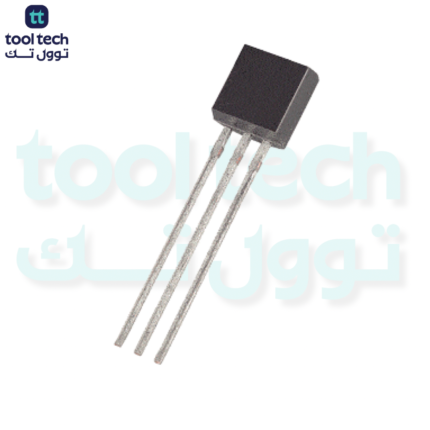
Description
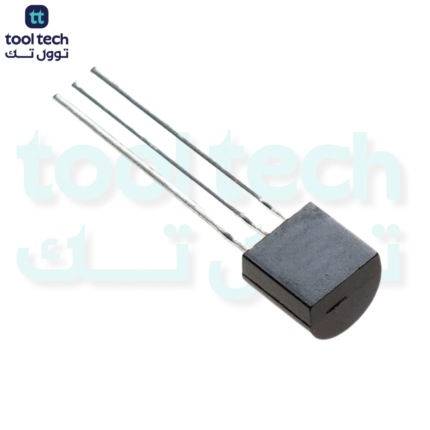
The BC338 is a medium-power NPN bipolar junction transistor (BJT) designed for general-purpose switching and amplification. It acts as a more robust “big brother” to small-signal transistors like the BC547, offering significantly higher current handling capabilities while maintaining a compact TO-92 footprint.
Key Specifications
| Parameter | Symbol | Rating |
| Collector-Emitter Voltage | $V_{CEO}$ | 25V (Standard) / 45V (BC338-40 variant) |
| Continuous Collector Current | $I_C$ | 800mA (0.8A) |
| Peak Collector Current | $I_{CM}$ | 1.5A |
| Power Dissipation | $P_D$ | 625mW |
| DC Current Gain | $h_{FE}$ | 60–400 (depending on gain group) |
| Transition Frequency | $f_T$ | 100MHz |
Why Choose the BC338?
-
Balanced Performance: It bridges the gap between low-power signal transistors (like the BC547/BC548) and high-power transistors (like the TIP series). It is small enough to fit easily on a breadboard but strong enough to drive small relays, LEDs, or low-power motors.
-
Efficient Switching: Because it is a single-stage BJT, it has a lower saturation voltage ($V_{CE(sat)}$) compared to Darlington-pair transistors. This makes it more efficient in battery-powered applications where heat management is critical.
-
Versatile Gain Groups: It is often classified by suffix (e.g., BC338-16, -25, -40), which helps designers choose the specific gain ($h_{FE}$) range required for their amplifier or switching circuit.
Important Design Considerations
-
Thermal Constraints: While the BC338 is rated for 800mA, it is still housed in a TO-92 plastic package. If you drive a load near 0.8A, the transistor will dissipate significant heat. Use a small clip-on heatsink or limit the duty cycle to prevent thermal runaway.
-
Base Drive Requirements: To ensure the transistor is fully “saturated” (fully ON) at 0.8A, you need a substantial base current (typically $40mA – 80mA$). If you are controlling this via a microcontroller (like an Arduino/ESP32), ensure your GPIO pin is not overloaded, or use an additional small-signal transistor as a driver.
-
Inductive Protection: When driving inductive loads like relays or small DC motors, the back-EMF generated when the transistor turns off can exceed the 25V–45V rating. Always use a flyback diode across the load to protect the transistor from voltage spikes.
Comparison: BC338 vs. Other Medium-Power BJTs
-
BC338 vs. BC639: The BC639 is rated for higher voltage (80V), while the BC338 is optimized for lower-voltage applications requiring up to 800mA.
-
BC338 vs. 2N2222: The 2N2222 is the classic hobbyist standard (rated for 600mA), while the BC338 offers a slightly higher current capacity (800mA) and different pinout configurations (check your specific datasheet).













Reviews
There are no reviews yet.