


Description
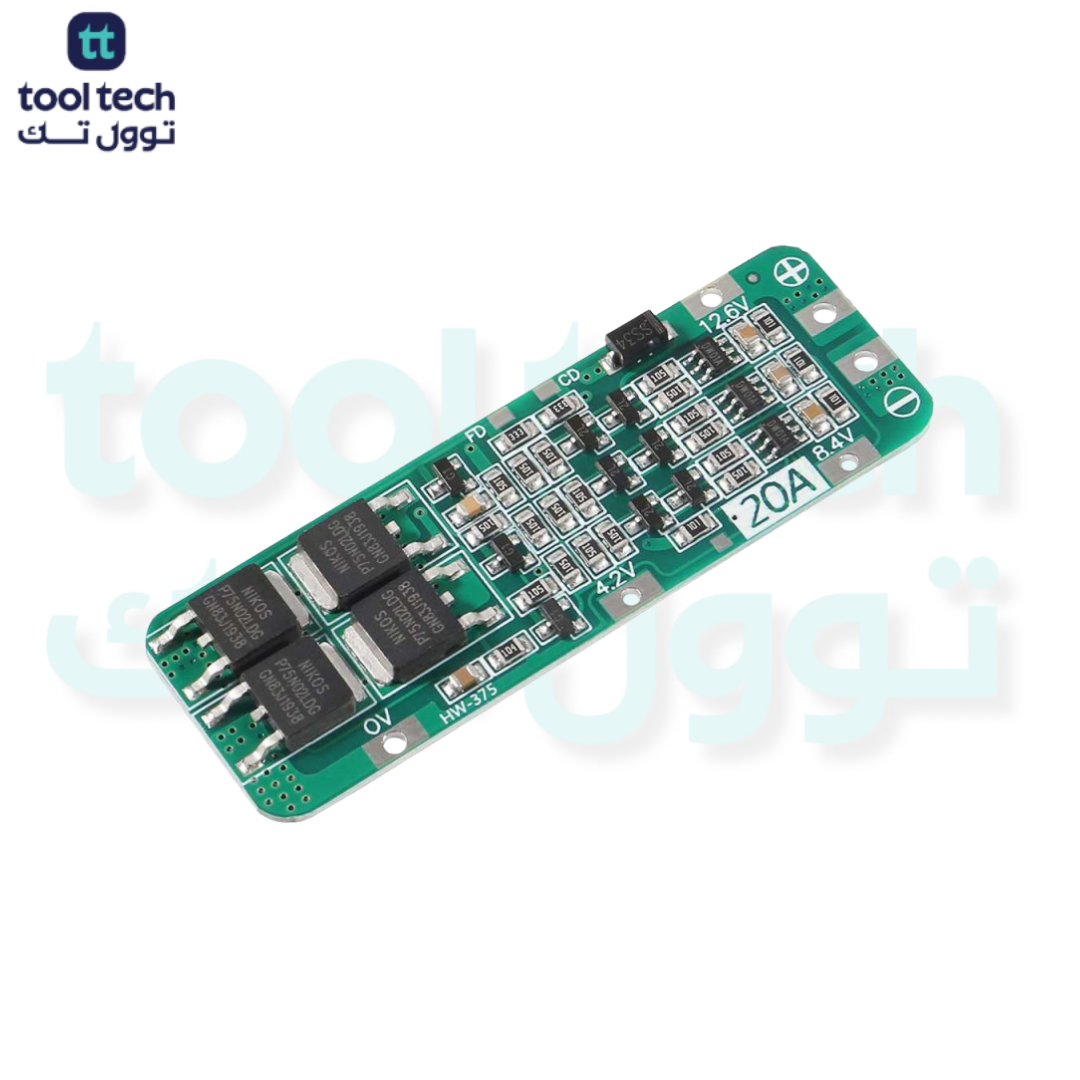
3S 20A Lithium Battery Management System (BMS)
The 3S 20A BMS is a reliable and efficient protection circuit designed for 3-series (3S) Lithium-ion or Lithium-polymer battery packs (11.1V nominal / 12.6V max). This board is the standard choice for medium-power applications where safety, cell longevity, and compact size are the primary requirements.
Technical Specifications
| Feature | Specification |
| Compatible Cells | 3-Series (11.1V nominal / 12.6V full) |
| Continuous Discharge | 20A |
| Instantaneous Current | Typically 30A–40A (Burst) |
| Charging Voltage | 12.6V (CC/CV) |
| Overcharge Threshold | 4.25V ± 0.05V |
| Over-discharge Threshold | 2.50V ± 0.1V |
| Balanced Charging | Integrated |
| Short Circuit Protection | Included |
Key Functions & Protections
-
Cell Balancing: Ensures each of the three cells maintains the same voltage level during the charging process. This prevents “capacity mismatch,” where one cell drains faster than others, which significantly extends the overall life of your pack.
-
Overload Protection: Monitors current flow to prevent damage from excessive loads. If your project experiences a short circuit or a sudden current spike, the BMS will instantly cut power to protect the cells and the circuitry.
-
Safety Thresholds: Provides automatic cutoff if the battery pack voltage exceeds safe limits (during charging) or drops below safe limits (during use), preventing chemical degradation or hazardous conditions.
-
Common Port Logic: Allows the same connection points for both the charger and the load, making the wiring process straightforward for custom pack builds.
Important Installation & Safety Guidelines
-
Wiring Sequence (Critical): Always solder your connections starting from the most negative cell (0V/B-), then the balance leads (B1, B2), and finally the positive end (B+). Plugging the balance cable into the BMS while it is already under load is the most common cause of board failure.
-
Charger Requirements: This BMS is designed to work with a dedicated 12.6V CC/CV (Constant Current/Constant Voltage) Lithium charger. Do not use a standard power supply or a car battery charger, as they lack the necessary current-limiting profile required for safe charging.
-
Thermal Considerations: While rated for 20A, if you operate the board near its maximum continuous capacity for long durations, ensure it is placed in an enclosure with adequate airflow, as the onboard MOSFETs will generate heat.
-
Wire Gauge: Use at least 16AWG or 18AWG wire for your main input/output lines to ensure low resistance and efficient power transfer.














Reviews
There are no reviews yet.