


Description
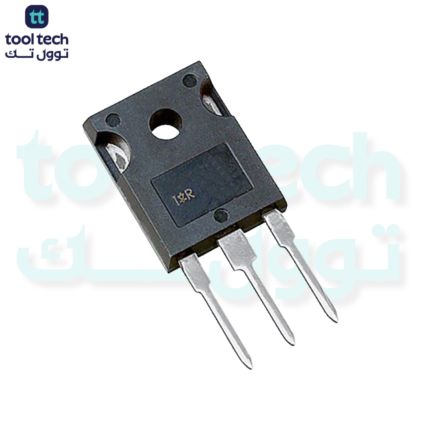
The IRFP240 is a robust N-Channel Power MOSFET designed for high-power applications. It is frequently favored in linear power amplifier designs and heavy-duty switching circuits because of its excellent thermal stability and rugged design.
Key Specifications
-
Transistor Type: N-Channel MOSFET
-
Drain-Source Voltage ($V_{DS}$): 200 V
-
Continuous Drain Current ($I_D$): 20 A (at $25^{\circ}\text{C}$)
-
On-Resistance ($R_{DS(on)}$): $0.18 \ \Omega$ (Max)
-
Power Dissipation ($P_D$): 150 W
-
Package Type: TO-247
Pinout Configuration
When looking at the front of the TO-247 package with the metal tab at the top and the pins pointing down, the pins from left to right are:
-
Gate (G)
-
Drain (D)
-
Source (S)
Comparison: IRFP240 vs. IRFP250
Both are 200V MOSFETs in the TO-247 package, but they are optimized for different priorities.
| Feature | IRFP240 | IRFP250 |
| Max Current ($I_D$) | 20 A | 30 A |
| $R_{DS(on)}$ | $0.18 \ \Omega$ | $0.075 \ \Omega$ |
| Power Dissipation | 150 W | 214 W |
-
Why choose the IRFP240? It is often selected for its superior linearity in audio amplification circuits. Many high-end audiophile amplifiers use the IRFP240/IRFP9240 complementary pair for their consistent performance across the gain range.
Common Applications
-
Audio Amplification: A standard component in high-fidelity (Hi-Fi) Class AB power amplifiers.
-
Switching Regulators: Used in DC-DC converters and power supplies.
-
Motor Drivers: Capable of handling high-torque motor applications, especially in H-bridge configurations.
Usage Best Practices
-
Linear vs. Switching: Unlike purely “switching” MOSFETs, the IRFP240 is highly regarded for its performance in the linear region. If you are building an audio amplifier, ensure you have a very large heatsink, as the transistor will be dissipating significant power as heat while operating in its linear range.
-
Thermal Management: Given its 150W rating, ensure the device is mounted to a substantial, finned aluminum heatsink using high-quality thermal grease or a sil-pad to avoid localized overheating.
-
Gate Resistor: To prevent high-frequency oscillations (ringing), always place a gate resistor ($22 \ \Omega$ to $100 \ \Omega$) as close to the Gate pin as possible.













Reviews
There are no reviews yet.