


Description
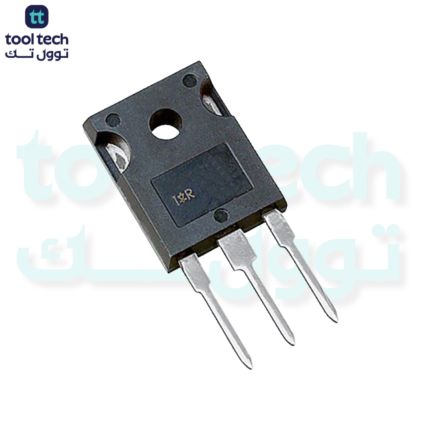
The IRFZ44N is an extremely popular N-Channel Power MOSFET, widely used in hobbyist and industrial electronics. It is prized for its low on-resistance and high current-handling capability, making it a go-to choice for low-voltage, high-current switching applications.
Key Specifications
-
Transistor Type: N-Channel MOSFET
-
Drain-Source Voltage ($V_{DS}$): 55 V
-
Continuous Drain Current ($I_D$): 49 A (at $25^{\circ}\text{C}$)
-
On-Resistance ($R_{DS(on)}$): $0.0175 \ \Omega$ (typical)
-
Power Dissipation ($P_D$): 94 W
-
Package Type: TO-220
Pinout Configuration
When looking at the front of the TO-220 package (the metal tab is at the top) with the pins pointing down, the pins from left to right are:
-
Gate (G)
-
Drain (D)
-
Source (S)
Why the IRFZ44N is so popular
Compared to high-voltage MOSFETs like the IRFP series, the IRFZ44N is optimized for “lower” voltage applications ($<55\text{V}$), such as automotive circuits (12V/24V) or battery-powered devices.
| Feature | IRFZ44N | IRFP250 |
| Max $V_{DS}$ | 55 V | 200 V |
| Max $I_D$ | 49 A | 30 A |
| $R_{DS(on)}$ | $0.0175 \ \Omega$ | $0.075 \ \Omega$ |
The lower $R_{DS(on)}$ means that for a given current, the IRFZ44N generates much less heat than higher-voltage MOSFETs, making it more efficient for high-current loads at lower voltages.
Common Applications
-
DC Motor Speed Control (PWM): It is the standard choice for driving DC motors using Pulse Width Modulation.
-
Battery Management: Used in solar charge controllers and power distribution switches for battery-operated systems.
-
LED Driving: Ideal for dimming high-power LED arrays or LED strips.
-
Inverters: Used in low-voltage power inverters (e.g., 12V to 110V/220V).
Essential Design Requirements
-
Gate Voltage ($V_{GS}$): While the threshold voltage ($V_{GS(th)}$) is typically 2V–4V, the IRFZ44N is not a “logic-level” MOSFET. To achieve the lowest $R_{DS(on)}$ and ensure it is fully “ON,” you should ideally drive the gate with 10V. If you drive it with a 3.3V or 5V microcontroller pin directly, it may not turn on fully, causing it to overheat.
-
Heatsinking: At 49A, the device will generate significant heat. Always use a heatsink. Even at moderate currents (e.g., 5A–10A), it is best practice to attach a small heatsink to the TO-220 tab.
-
Gate Protection: Because the gate is sensitive, it is recommended to place a $10\text{k}\Omega$ resistor between the Gate and Source to ensure the MOSFET stays “OFF” when the control signal is floating.














Reviews
There are no reviews yet.