

Description
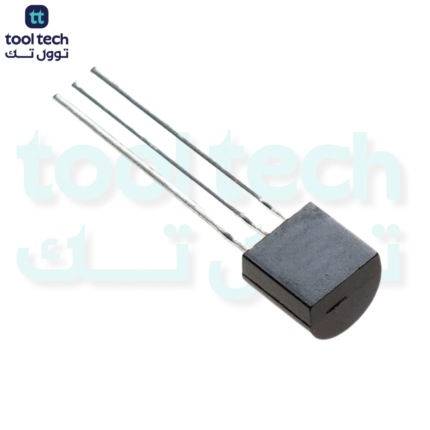
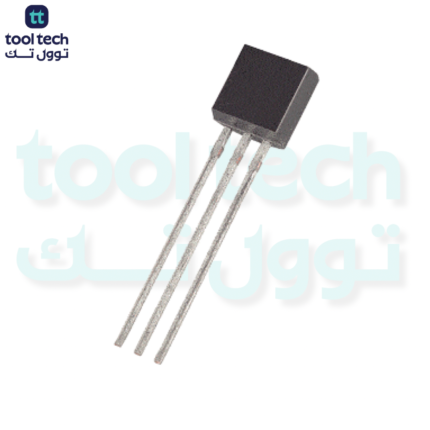
The BC238 is a general-purpose, low-power NPN bipolar junction transistor (BJT). It is a classic component often found in older audio equipment, low-voltage control circuits, and small-signal amplification stages.
Key Specifications
| Parameter | Symbol | Rating |
| Collector-Emitter Voltage | $V_{CEO}$ | 25V |
| Continuous Collector Current | $I_C$ | 100mA (0.1A) |
| Power Dissipation | $P_D$ | 300mW |
| DC Current Gain | $h_{FE}$ | 100–800 (classification dependent) |
| Transition Frequency | $f_T$ | 150MHz |
Core Characteristics & Applications
-
Low-Power Signal Processing: With a current limit of 100mA and a voltage limit of 25V, the BC238 is strictly for small-signal tasks. It is not suitable for driving motors, solenoids, or high-power LEDs.
-
Audio Amplification: It is frequently used in the early stages of audio circuits (pre-amplifiers) where the signal levels are low. Its high-frequency response allows for good linearity in audio bands.
-
Low-Voltage Switching: It can be used to drive tiny indicator LEDs (with a suitable resistor) or to act as a logic-level switch for other small-signal components.
Implementation Guidelines
-
Voltage Constraints: The 25V $V_{CEO}$ limit is quite low by modern standards. Avoid using this in circuits with 24V supply rails, as any voltage fluctuations (spikes) could easily exceed the 25V threshold and cause the transistor to fail. It is best suited for 5V, 9V, or 12V systems.
-
Pinout: Like most transistors in the TO-92 package, looking at the flat side with the leads facing down, the pins are Collector (1), Base (2), Emitter (3). Note: Always check the datasheet from your specific manufacturer to be 100% certain.
-
General-Purpose Replacement: Because it is an older component, you may sometimes find it replaced by the BC548 in modern designs, as the BC548 offers a higher voltage rating (30V) and is more widely available today.
Summary Comparison
-
BC238: 25V, 0.1A (Classic, general-purpose).
-
BC548: 30V, 0.1A (Modern, standard equivalent).
-
BC550: 45V, 0.1A (Low-noise variant for audio).













Reviews
There are no reviews yet.