
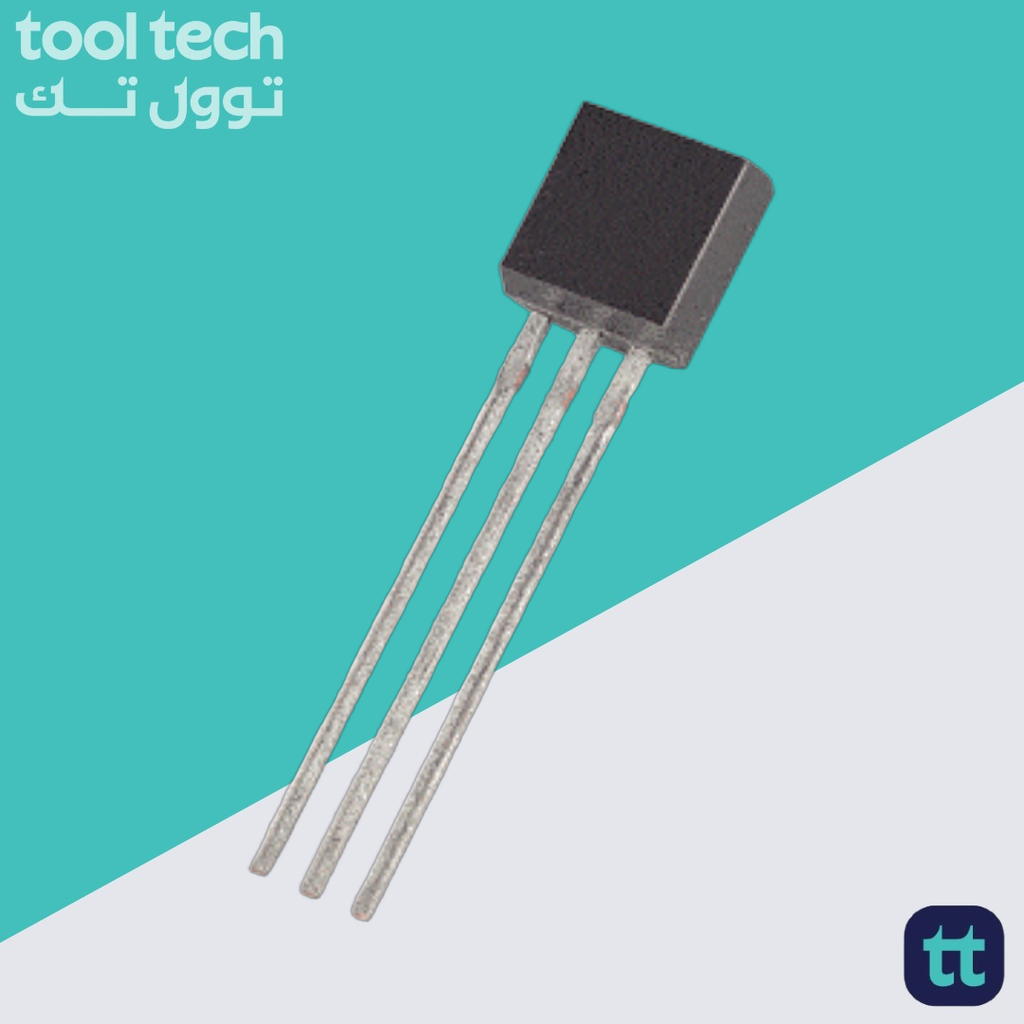


Description
The BC337 is a very popular, general-purpose NPN bipolar junction transistor (BJT). It is the NPN complement to the BC327 and is widely used for medium-power switching and amplification tasks in hobbyist and professional electronics.
Key Specifications
-
Transistor Type: NPN
-
Maximum Collector Current ($I_C$): 800 mA
-
Collector-Emitter Voltage ($V_{CE}$): 50 V
-
Collector-Base Voltage ($V_{CB}$): 50 V
-
Package Type: TO-92
-
DC Current Gain ($h_{FE}$): 100 to 630 (divided into groups: -16, -25, -40)
-
Power Dissipation ($P_C$): 625 mW
Pinout Configuration
When looking at the flat side of the TO-92 package with the leads pointing down, the pins from left to right are:
-
Collector
-
Base
-
Emitter
Comparison: BC327 vs. BC337
Because these two transistors are designed to be complements, they are frequently paired in “Push-Pull” amplifier configurations.
| Feature | BC327 | BC337 |
| Type | PNP | NPN |
| Max $V_{CE}$ | 45 V | 50 V |
| Max $I_C$ | 800 mA | 800 mA |
| Primary Logic | Pull-up switching | Pull-down switching |
Usage Notes
-
NPN Switching: As an NPN transistor, the BC337 is “off” when the base is at ground potential. To turn it “on” (allowing current to flow from Collector to Emitter), you must apply a positive voltage (typically $>0.7\text{V}$) to the base relative to the emitter.
-
Saturation: To ensure the transistor acts as an efficient switch, ensure the base current ($I_B$) is sufficient to drive the transistor into saturation. A common rule of thumb is to set $I_B \approx \frac{I_C}{10}$.
-
Protection: When driving inductive loads (like small DC motors or relay coils), always place a flyback diode (such as a 1N4148 or 1N4007) in parallel with the load to protect the transistor from high-voltage spikes caused by the collapsing magnetic field.













Reviews
There are no reviews yet.