


Description
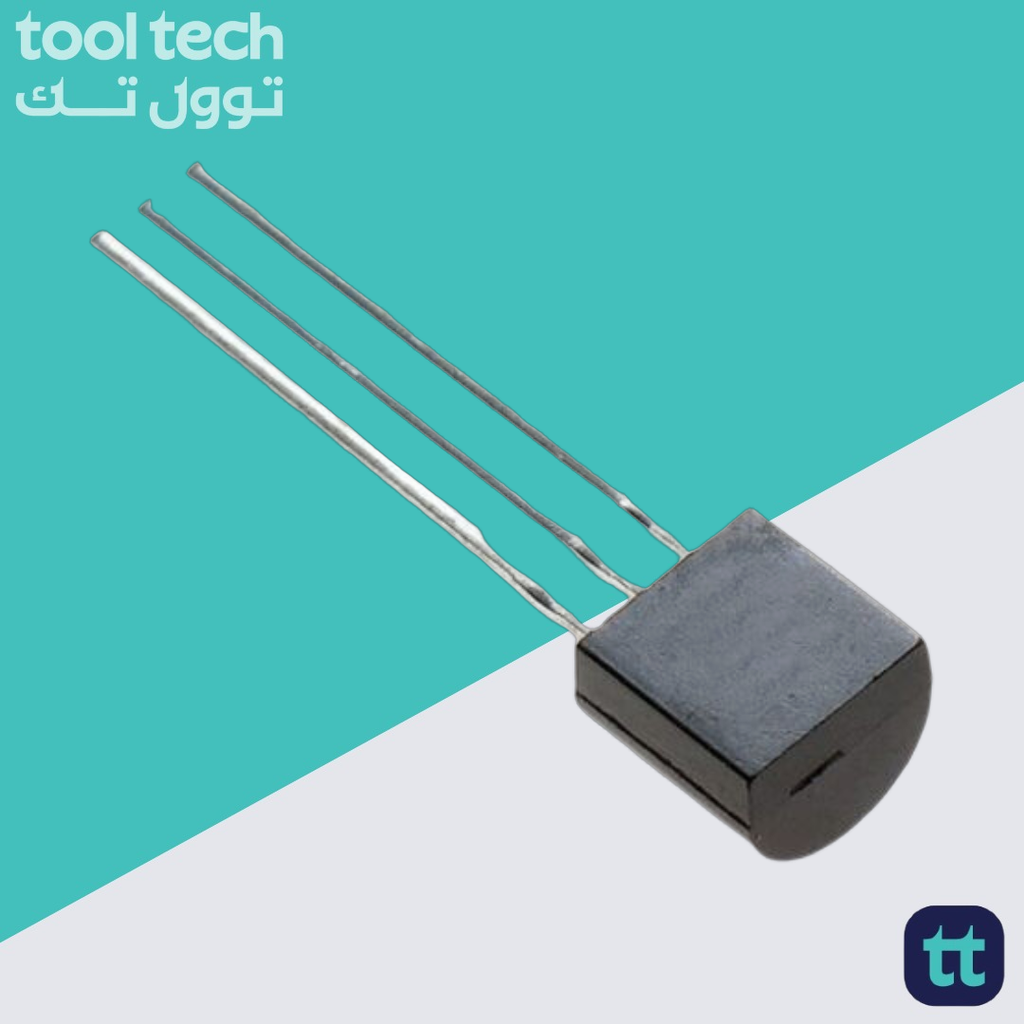
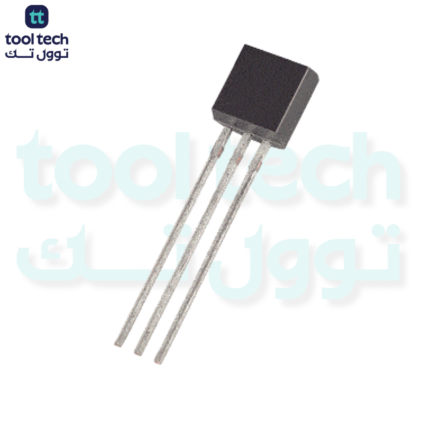
The BC368 is a medium-power NPN bipolar junction transistor (BJT) designed for switching and amplification applications that require moderate current (up to 2A) at relatively low voltages.
Key Specifications
| Parameter | Symbol | Rating |
| Collector-Emitter Voltage | $V_{CEO}$ | 20V |
| Continuous Collector Current | $I_C$ | 2A |
| Peak Collector Current | $I_{CM}$ | 4A |
| Power Dissipation | $P_D$ | 625mW |
| DC Current Gain | $h_{FE}$ | 85–375 (at 500mA) |
| Transition Frequency | $f_T$ | 100MHz |
Key Characteristics & Applications
-
High Current for TO-92: The BC368 is notable for its ability to handle up to 2A of continuous current despite its small TO-92 package. This makes it a great “compact” switch for small DC motors, solenoids, or driving high-current LED strings.
-
Low-Voltage Operation: With a $V_{CEO}$ of 20V, it is primarily intended for battery-powered circuits (e.g., 3.3V, 5V, 9V, or 12V rails). It should not be used in 24V or higher circuits as it will likely suffer from voltage breakdown.
-
Switching Efficiency: Because it is a single-stage BJT, it is more efficient than a Darlington transistor (like the TIP122) in low-current scenarios, as it avoids the ~2V voltage drop typical of Darlington pairs.
Critical Implementation Notes
-
Thermal Management: The 625mW power dissipation rating is the “Achilles’ heel” of this device. If you operate this transistor at 1A or 2A, it will dissipate heat very quickly. Without a heatsink, it will overheat and fail within seconds of continuous operation. If your load requires 2A, this transistor is best used in pulsed applications (like PWM) rather than a continuous “on” state.
-
Base Current: To switch a 2A load effectively, you need a significant base current (usually $100mA – 200mA$). If you are driving this from a microcontroller, you must use a pre-driver transistor (like a 2N3904) to provide the necessary base drive.
-
Flyback Protection: As with all transistors driving inductive loads (motors/relays), you must place a flyback diode (like the 1N4007) across the load. Given the 20V limit, any voltage spike from an inductive load will easily destroy the BC368.
Comparison
-
BC368 (NPN) vs. BC369 (PNP): The BC368 is the NPN version (low-side switch), while the BC369 is its PNP complement (high-side switch). They are often used together in push-pull driver circuits.
-
BC368 vs. TIP120: If your project voltage is 12V or less, the BC368 is more compact. If you need to handle 24V or more, you must switch to a TIP120 or similar device.














Reviews
There are no reviews yet.