

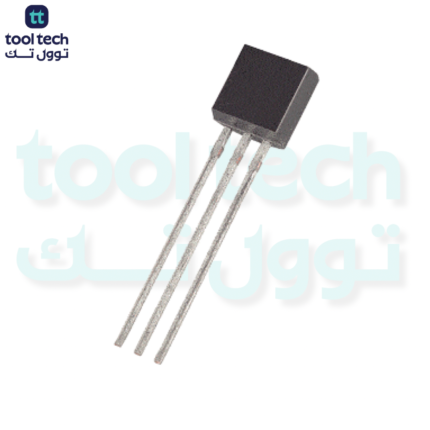
Description
The BC548 is a ubiquitous, general-purpose NPN bipolar junction transistor (BJT). It is essentially the “workhorse” of low-power electronics, widely favored for signal amplification, small-signal switching, and hobbyist circuit design.
Key Specifications
-
Transistor Type: NPN
-
Maximum Collector Current ($I_C$): 100 mA (0.1 A)
-
Collector-Emitter Voltage ($V_{CE}$): 30 V
-
Power Dissipation ($P_C$): 500 mW
-
Package Type: TO-92
Pinout Configuration
When viewing the flat side (the face with the markings) of the TO-92 package with the leads pointing downward, the pin arrangement from left to right is:
-
Collector
-
Base
-
Emitter
Comparison with BC337
It is common to confuse the BC548 with the BC337. While they are both NPN transistors, they serve different purposes based on their current handling capabilities:
| Feature | BC548 | BC337 |
| Max Current ($I_C$) | 100 mA | 800 mA |
| Primary Use | Signal/Small-signal | Medium-power/Drivers |
| Package | TO-92 | TO-92 |
Why use the BC548?
-
High Gain ($h_{FE}$): The BC548 is prized for its high current gain, making it excellent for amplifying very small signals, such as those from sensors (e.g., LDRs, thermistors, or microphones).
-
Low Noise: It is designed for low-noise operation, which is critical in audio pre-amplifier circuits.
-
Cost-Effectiveness: Because it is produced in massive volumes, it is one of the most inexpensive and accessible transistors available.
Usage Best Practices
-
Current Limits: Unlike the BC337, the BC548 will be destroyed quickly if you attempt to drive motors or large relay coils. Always check the current requirements of your load to ensure they stay well below 100 mA.
-
Biasing: In amplifier configurations, the BC548 requires careful biasing (usually using a voltage divider at the base) to operate in the linear region.
-
Complementary Pair: If you require a PNP equivalent to the BC548 for symmetrical circuits, the BC558 is the direct partner.













Reviews
There are no reviews yet.