


Description
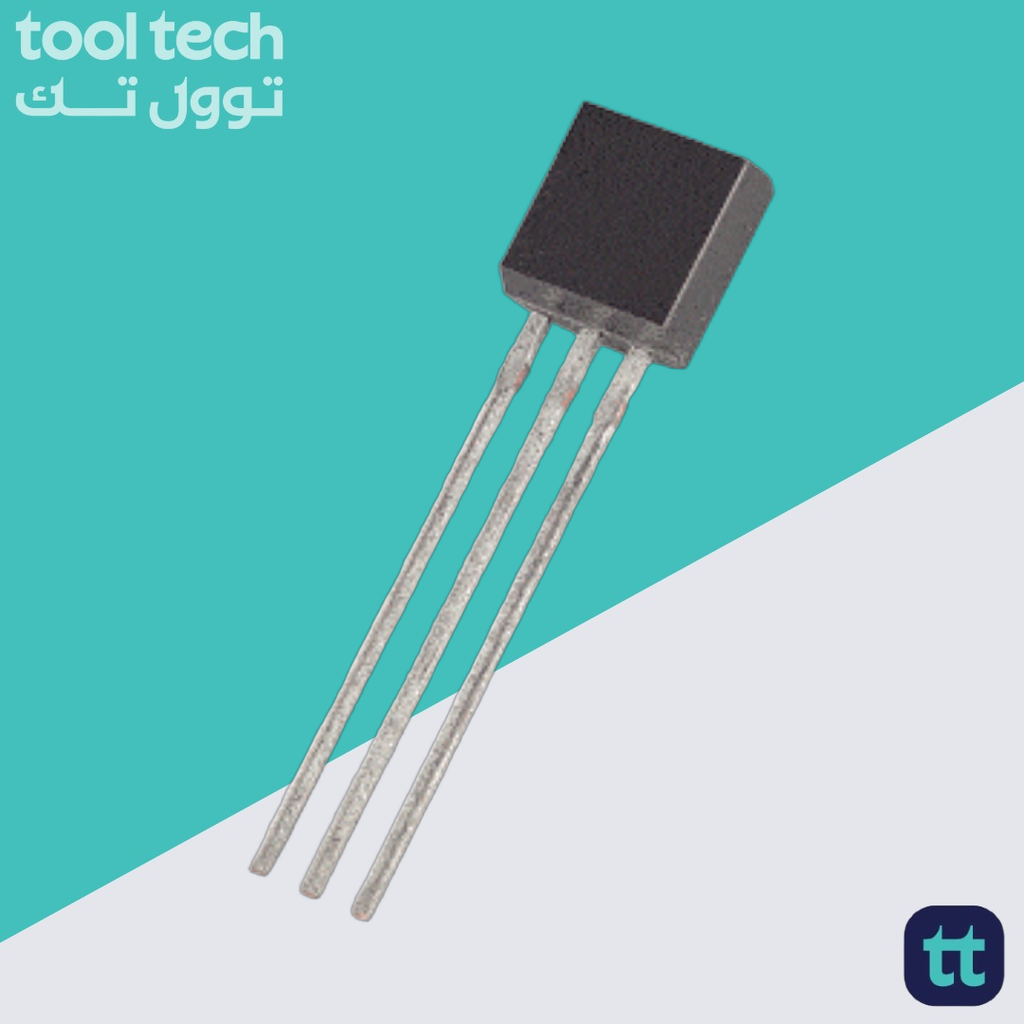
The BC558 is a general-purpose PNP bipolar junction transistor (BJT). It is the direct PNP complement to the BC548 (NPN) and is widely used for low-power switching and signal amplification in small-signal circuits.
Key Specifications
-
Transistor Type: PNP
-
Maximum Collector Current ($I_C$): 100 mA (0.1 A)
-
Collector-Emitter Voltage ($V_{CE}$): 30 V
-
Power Dissipation ($P_C$): 500 mW
-
Package Type: TO-92
-
Gain ($h_{FE}$): Typically 110–800 (depending on the A, B, or C suffix)
Pinout Configuration
When looking at the flat side (the face with the markings) of the TO-92 package with the leads pointing downward, the pin arrangement from left to right is:
-
Collector
-
Base
-
Emitter
Comparison: BC558 vs. BC548
These two transistors are designed to work together as a pair. Because they have nearly identical electrical characteristics but opposite polarities, they are the go-to choice for symmetrical circuits like push-pull amplifiers.
| Feature | BC558 (PNP) | BC548 (NPN) |
| Max $I_C$ | 100 mA | 100 mA |
| Max $V_{CE}$ | 30 V | 30 V |
| Primary Logic | Pull-up switching | Pull-down switching |
Key Applications
-
Small-Signal Amplification: Used extensively in audio pre-amplifier stages due to its low-noise design.
-
Switching: Ideal for high-side switching in low-current circuits (e.g., turning on an LED by pulling the line to the positive supply rail).
-
Sensor Interfacing: Frequently used as a buffer or amplifier for low-voltage sensor outputs.
Usage Best Practices
-
Polarity: As a PNP transistor, remember that the emitter must be at a higher potential than the base to turn the transistor “on.” To switch a load, you generally apply a low signal (ground) to the base to allow current to flow from the Emitter to the Collector.
-
Loading: The BC558 is for small-signal use. If you need to switch larger currents (above 100 mA), you should use the BC558 as a “driver” to control the base of a higher-power transistor, such as the BC327.
-
Heat: Ensure that your circuit design keeps the power dissipation well within the 500 mW limit.













Reviews
There are no reviews yet.