


Description
The IRF740 is a versatile, high-voltage N-Channel Power MOSFET. It is widely used in high-voltage switching applications where the voltage requirements exceed what low-voltage parts like the IRFZ44N can handle, but where the current needs remain moderate (under 10A).
Key Specifications
-
Transistor Type: N-Channel MOSFET
-
Drain-Source Voltage ($V_{DS}$): 400 V
-
Continuous Drain Current ($I_D$): 10 A (at $25^{\circ}\text{C}$)
-
On-Resistance ($R_{DS(on)}$): $0.55 \ \Omega$ (Max)
-
Power Dissipation ($P_D$): 125 W
-
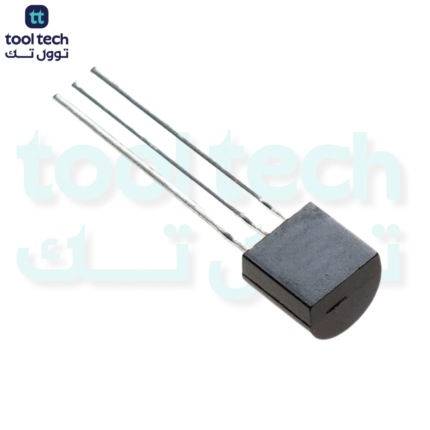
Package Type: TO-220
Pinout Configuration
When looking at the front of the TO-220 package (the metal tab is at the top) with the pins pointing down, the pins from left to right are:
-
Gate (G)
-
Drain (D)
-
Source (S)
Comparison: IRF740 vs. IRF830
Both are high-voltage MOSFETs, but they are optimized for different power levels.
| Feature | IRF740 | IRF830 |
| Max Voltage ($V_{DS}$) | 400 V | 500 V |
| Max Current ($I_D$) | 10 A | 4.5 A |
| $R_{DS(on)}$ | $0.55 \ \Omega$ | $1.5 \ \Omega$ |
-
Selection Insight: The IRF740 provides a better balance of lower on-resistance and higher current capability, making it more efficient for moderate-power applications. The IRF830 is only chosen when the extra 100V of blocking capability is strictly required.
Common Applications
-
Switch-Mode Power Supplies (SMPS): Commonly used in the primary side of offline power supplies.
-
Lighting Systems: Used in ballasts for HID lamps or professional stage lighting.
-
Motor Control: Suitable for high-voltage DC motors or controlling actuators that require significant voltage.
-
Inverters: Often found in small-scale DC-to-AC power inverters.
Usage Best Practices
-
-
Gate Drive: To ensure the MOSFET fully turns ON and stays in the low-resistance state, use a gate drive voltage of 10V. Using a 5V logic signal directly can result in the device running partially “ON,” which leads to rapid heating and failure.
-
-
Heatsinking: At $I_D = 10\text{A}$, the power loss ($I^2R$) is roughly $10^2 \times 0.55 = 55\text{W}$. Even at 5A, it will dissipate $\approx 14\text{W}$. A robust, finned heatsink is mandatory for these current levels.
-
Voltage Spikes: Since it is rated for 400V, ensure that your circuit design includes protection against inductive flyback spikes. A snubber circuit (typically a resistor and capacitor in series) connected across the drain-to-source pins can absorb these high-voltage transients.













Reviews
There are no reviews yet.