


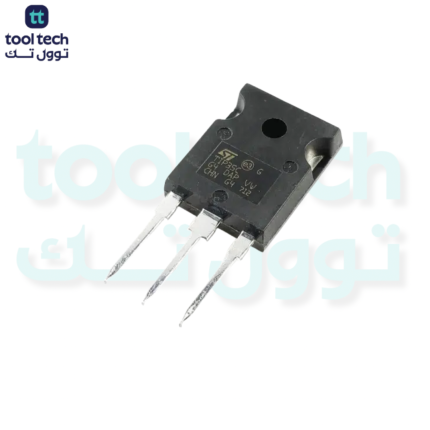
Description
Actually, there is a very important distinction to make here: The TIP41C is not a Darlington transistor.
While it is often grouped with the “TIP” series (like the TIP12x or TIP11x series), the TIP41C is a standard, single-stage NPN power transistor.
Clarification: TIP41C vs. Darlington Transistors
Unlike the Darlington transistors you have been researching, the TIP41C does not contain two internal transistors stacked in a pair. It is a single BJT (Bipolar Junction Transistor). This is a critical distinction for your circuit design:
-
Gain ($h_{FE}$): The TIP41C has a much lower current gain (typically 15 to 75) compared to the 1,000+ gain of a Darlington.
-
Base Drive: Because of this lower gain, you cannot drive the TIP41C directly from a low-power microcontroller pin with the same ease as a Darlington. You will likely need an additional driver transistor to provide enough base current to fully saturate the TIP41C.
-
Voltage Drop: Because it is a single-stage transistor, its $V_{CE(sat)}$ is much lower (typically $\le 1.5V$ at 6A) than a Darlington’s, meaning it runs cooler and is more efficient at high currents.
Key Specifications: TIP41C
| Parameter | Symbol | Rating |
| Collector-Emitter Voltage | $V_{CEO}$ | 100V |
| Continuous Collector Current | $I_C$ | 6A |
| Peak Collector Current | $I_{CM}$ | 10A |
| Collector-Emitter Saturation Voltage | $V_{CE(sat)}$ | 1.5V (at 6A) |
| DC Current Gain | $h_{FE}$ | 15–75 (at 3A) |
| Power Dissipation | $P_D$ | 65W |
Design Implications
-
High-Current Efficiency: If you are driving a 6A load, the TIP41C is more efficient than a Darlington like the TIP122. A Darlington would drop ~2.5V, while the TIP41C drops ~1.5V. This 1V difference saves you about 6 Watts of waste heat at full load.
-
Driving Requirements: To turn a TIP41C “fully ON” at 6A with a gain of 15, you need a base current of roughly $I_B = I_C / h_{FE} = 6A / 15 = 400mA$. A standard Arduino/ESP32 GPIO pin cannot supply 400mA. You will need a small signal transistor (like a 2N2222) to act as a pre-driver to supply that base current.
-
Application: The TIP41C is a classic workhorse for linear power supplies, audio output stages, and high-speed switching where the ultra-high gain of a Darlington isn’t needed, but high-current efficiency is desired.
Should you use a TIP41C?
-
Choose the TIP41C if you need high efficiency, can provide a robust base-drive circuit, and want to minimize heat generation.
-
Choose a Darlington (like the TIP102 or TIP122) if you want the simplest possible circuit where the transistor is driven directly by a microcontroller and you don’t mind the extra heat from the Darlington’s higher voltage drop.












Reviews
There are no reviews yet.