

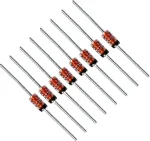

Description
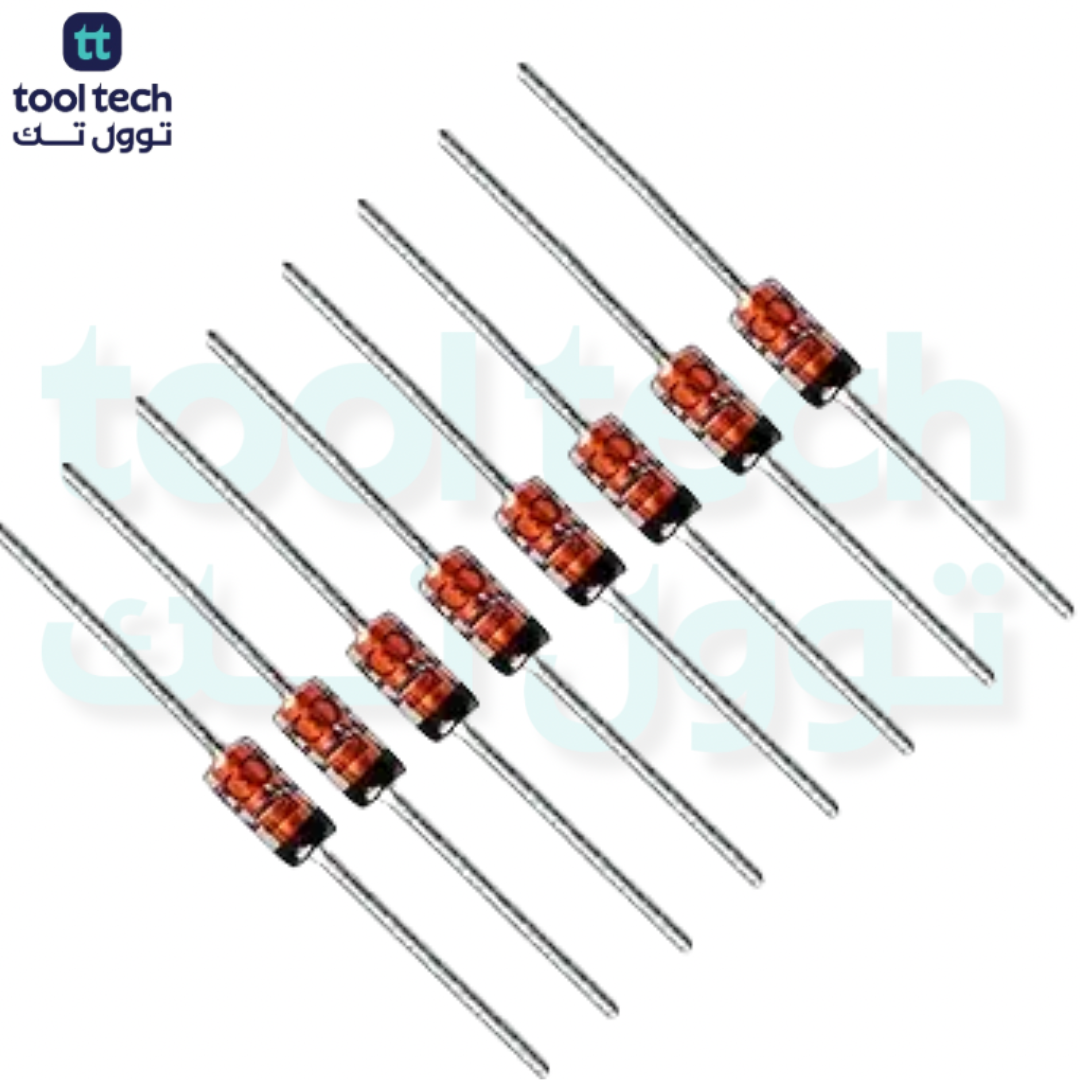
The marking “C3V9PH” identifies a 3.9V Zener diode. In industry-standard coding (commonly associated with Philips/NXP), the “V” represents the decimal point, identifying the nominal Zener voltage as 3.9V. The “PH” is a manufacturer-specific batch or factory identifier.
Technical Overview
The C3V9PH is a precision 3.9V Zener diode primarily used for voltage regulation and signal clipping in low-voltage digital and analog circuits. Given the voltage threshold, it is frequently employed to protect sensitive microcontrollers and digital logic interfaces from voltage spikes.
Technical Specifications
| Parameter | Specification |
| Nominal Zener Voltage ($V_Z$) | 3.9V |
| Power Dissipation ($P_D$) | 500mW (0.5W) |
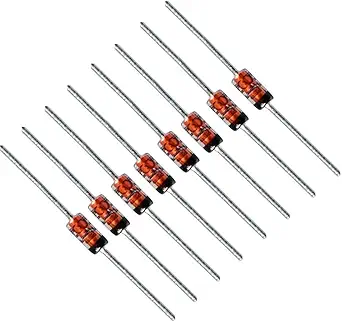
| Package Type | DO-35 (Glass Axial Lead) |
| Tolerance | $\pm 5\%$ |
| Operating Temperature | -65°C to +200°C |
Understanding the Zener Breakdown
A Zener diode like the C3V9PH is designed to operate in the reverse bias region. When the voltage applied across it is below 3.9V, it remains in a high-impedance state (blocking current). Once the voltage exceeds 3.9V, the diode enters the “breakdown” state, clamping the voltage at a stable 3.9V by shunting excess current to ground.
Application & Replacement Notes
-
Signal Protection: If this component is connected to a sensor or data input line, its role is to clamp high-voltage transients to 3.9V to prevent damage to the downstream processing chip.
-
Replacement: When replacing this component, ensure you use a 3.9V Zener diode with a 500mW power rating in a DO-35 package. Using a diode with a higher power rating (e.g., 1W) is generally safe, provided the physical size fits the PCB layout, but avoid using a lower-rated device.
-
Verification: If the component has failed (typically shorted), it is often the result of an upstream overvoltage event. Before installing a new one, verify the integrity of the power supply or the signal line that feeds the diode.















Reviews
There are no reviews yet.