





Description
The DB3 is a bidirectional trigger diode, commonly referred to as a DIAC (Diode for Alternating Current). Unlike the rectifier diodes we discussed previously (1N4007 or 1N5408), which allow current in only one direction, the DB3 is designed specifically for triggering applications.
It remains in a high-resistance (non-conducting) state until the voltage across it reaches its “breakover voltage.” Once that threshold is exceeded, it switches to a low-resistance state, allowing current to flow in either direction.
Technical Specifications
| Parameter | Typical Value |
| Breakover Voltage ($V_{BO}$) | 28V – 36V |
| Breakover Current ($I_{BO}$) | ~50 µA |
| Peak Pulse Current ($I_{TRM}$) | 2.0 A (10 µs duration) |
| Power Dissipation ($P_D$) | 150 mW |
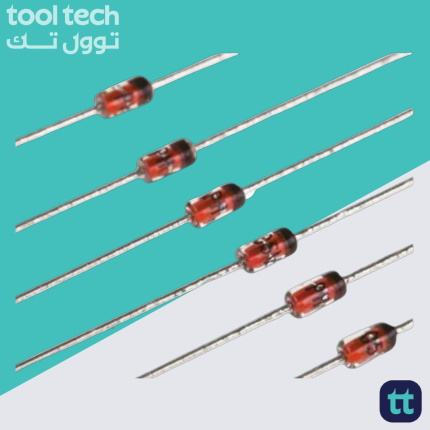
| Package Type | DO-35 (Axial) |
How It Works: The “Snap-Back” Effect
The DIAC acts like a voltage-controlled switch.
-
Blocking Mode: Below its breakover voltage (e.g., < 30V), the DIAC acts as an insulator, blocking current.
-
Triggering: As the voltage increases and crosses the $V_{BO}$ threshold, the DIAC experiences negative resistance—its internal resistance drops sharply.
-
Conduction: It “fires,” dumping a pulse of current to the gate of a switching component (like a TRIAC).
-
Reset: Once the current falls below the “holding current,” the DIAC resets to its blocking state.
Typical Applications
-
TRIAC Triggering: This is the most common use. In AC dimmers and motor speed controllers, the DIAC ensures the TRIAC fires at a consistent voltage level on both the positive and negative half-cycles of the AC waveform.
-
Lamp Dimmers: Used in household light dimmers to provide phase-angle control.
-
Universal Motor Speed Control: Used in power tools and appliances to regulate speed.
-
Starter Circuits: Often used in electronic ballasts for fluorescent lamps.
Important Design Considerations
-
Symmetry: Because it is bidirectional, the breakover voltage is nearly identical for both polarities. This symmetry is vital for smooth control of AC loads.
-
Not for Rectification: Never use a DIAC in place of a standard rectifier diode; it will not convert AC to DC and will likely cause a short circuit or erratic behavior in your circuit.
-
Polarity: Being bidirectional, the DIAC is non-polarized. You can install it in either direction without affecting its operation.
Summary Comparison
| Diode Type | Function | Flow | Primary Use |
| 1N4007/1N5408 | Rectifier | Unidirectional | AC-DC conversion, protection |
| DB3 (DIAC) | Trigger | Bidirectional | Triggering TRIACs, dimmers |















Reviews
There are no reviews yet.