


Description
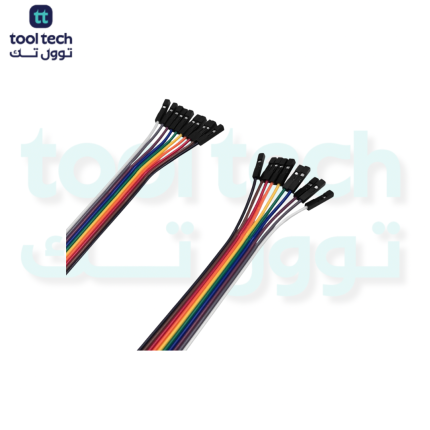
The product is known as Female-to-Female (F-F) DuPont Jumper Wires. The specifications for the 20 cm version are nearly identical to the 30 cm version, with the primary difference being the shorter length, which is often preferred for more compact or neat wiring setups on a breadboard.
Product Specifications
| Feature | Specification |
| Product Name | Female to Female (F-F) DuPont Jumper Wires |
| Connector Gender | Female to Female (sockets on both ends) |
| Length | 20 cm (~8 inches) |
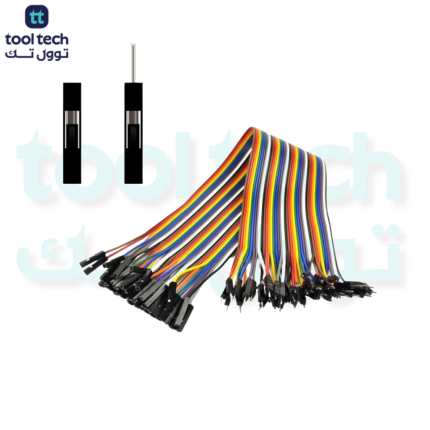
| Quantity per Pack | 40 wires (provided as an easily separable ribbon) |
| Pin Pitch | 2.54 mm (0.1 inch) |
| Material | Multi-strand copper wire with PVC insulation |
| Compatibility | Standard breadboards, male header pins (Arduino, Raspberry Pi, etc.) |
| Color Scheme | 10 colors (rainbow sequence for identification) |
Key Differences & Benefits of the 20 cm Length
-
Reduced Clutter: In smaller prototyping setups, 20 cm wires are often easier to manage and create a tidier look than 30 cm wires, which may leave excess slack.
-
Signal Integrity: While length has a negligible effect on most hobbyist logic signals, shorter wires have slightly less resistance and are less prone to acting as antennas for electromagnetic interference (EMI).
-
Prototyping Utility: These are ideal for connecting components that are positioned close to each other on a breadboard or within a small enclosure.
Usage Note
Like the 30 cm version, these arrive as a “ribbon” cable of 40 wires. They are designed to be easily peeled apart by hand, allowing you to create custom-sized bundles (e.g., a 3-wire set for a sensor or a 6-wire set for an LCD display) based on your project requirements.
Are you looking to use these for a specific project, or are you trying to decide which length (20 cm vs 30 cm) would be better for your current setup?

















Reviews
There are no reviews yet.