




Description
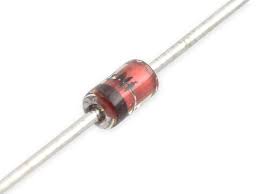
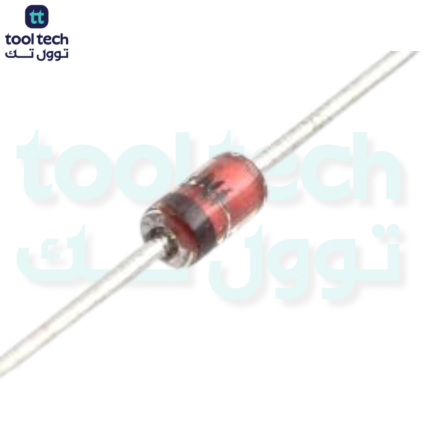
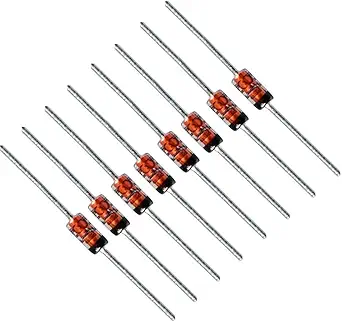
The 3.6V 1W Zener diode is a higher-power variant of the standard 3.6V regulator. While small signal diodes are often 0.5W (DO-35), the 1W rating requires a more robust thermal package to dissipate heat effectively. Common industry-standard parts for this include the 1N4729 (or the BZX85-C3V6 series).
Technical Specifications
| Parameter | Specification |
| Nominal Zener Voltage ($V_Z$) | 3.6V |
| Power Dissipation ($P_D$) | 1.0W (1000mW) |
| Package Type | DO-41 (Larger Plastic/Glass Axial) |
| Tolerance | $\pm 5\%$ |
| Operating Temperature | -65°C to +200°C |
Understanding the Zener Principle
Like other Zeners, this component is designed to operate in the reverse breakdown region. When the voltage across the diode reaches 3.6V, it begins to conduct significantly, shunting excess current to ground and holding the voltage stable at 3.6V.
Because this diode is rated for 1W, it can handle higher current loads than the standard 0.5W versions. However, it still requires a series current-limiting resistor ($R_s$) to prevent the device from drawing infinite current and destroying itself.
Application & Replacement Notes
-
Thermal Capacity: With a 1W rating, you can safely pass up to roughly 270mA of current through this device ($1W / 3.6V = 0.277A$), provided you have adequate ventilation or a PCB trace designed to act as a heat sink.
-
Component Selection: If you are replacing a faulty diode, pay attention to the package size. A 1W diode in a DO-41 package is physically larger than a 0.5W diode in a DO-35 package. Installing a 0.5W diode in a circuit designed for 1W may lead to premature failure due to overheating.
-
Troubleshooting: If the 3.6V rail is failing, check the diode for a short circuit. If you find the diode is burnt or the PCB is discolored, ensure the series resistor has not decreased in value or that the upstream voltage has not spiked beyond the safe input limits.













Reviews
There are no reviews yet.