



Description
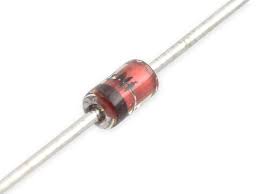
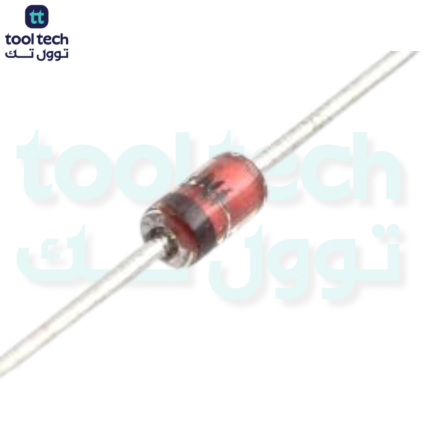
The 3.3V Zener diode is a critical component for voltage regulation in modern electronics, specifically because it matches the operating voltage of many low-power microcontrollers and digital logic families (e.g., 3.3V LVTTL). The most common industry-standard part for this specification is the BZX79-C3V3 or 1N5226.
Technical Specifications
| Parameter | Specification |
| Nominal Zener Voltage ($V_Z$) | 3.3V |
| Power Dissipation ($P_D$) | 0.5W (500mW) |
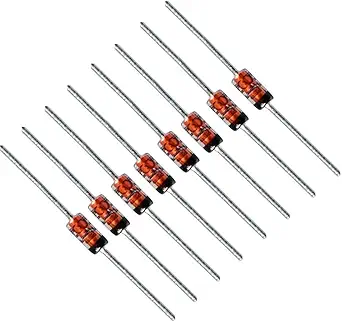
| Package Type | DO-35 (Glass Axial Lead) |
| Tolerance | $\pm 5\%$ |
| Operating Temperature | -65°C to +200°C |
Understanding Operation
The 3.3V Zener operates in the reverse breakdown region. It is frequently used in two primary configurations:
-
Shunt Regulator: Keeps a supply rail stable at 3.3V. It requires a series resistor ($R_s$) to limit current.
-
Voltage Clamp (Protection): Placed in parallel with a data signal to prevent voltage spikes from exceeding the 3.3V threshold, which protects sensitive I/O pins of microcontrollers.
Application & Replacement Notes
-
Current Limitation: Because this is a 500mW device, you must ensure the current ($I_Z$) through the diode does not exceed the limit. Using $I_{Zmax} = P_D / V_Z$, the maximum current should be kept below ~150mA ($0.5W / 3.3V$); however, for long-term reliability in regulation, it is standard practice to operate well below this maximum.
-
Replacement: When replacing, ensure you source a 3.3V, 500mW Zener in the DO-35 package to match your PCB footprint.
-
Troubleshooting: If the voltage on your 3.3V line is pulling low, check the Zener. A common failure mode for these diodes is a short circuit, which will effectively ground your voltage rail.













Reviews
There are no reviews yet.