




Description
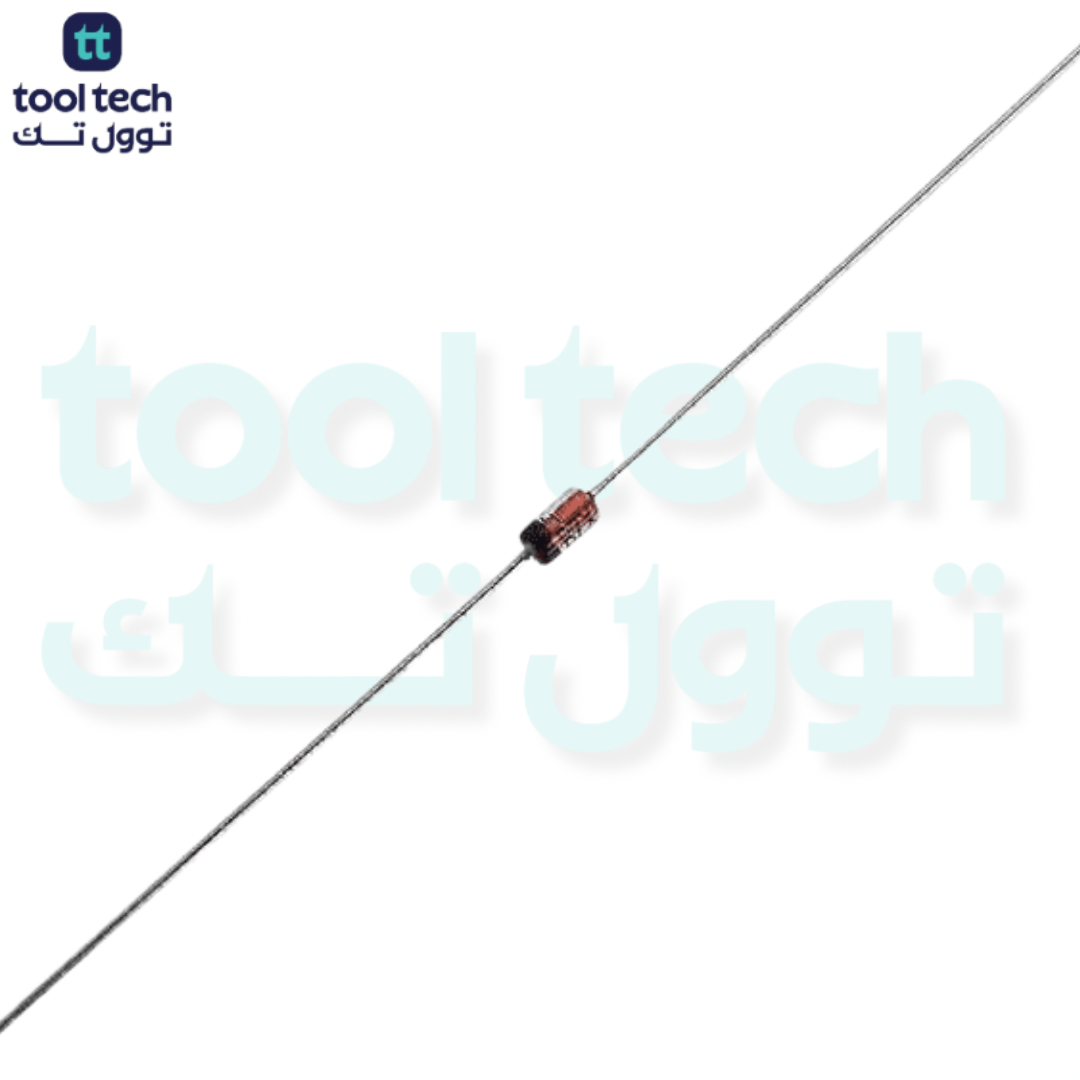
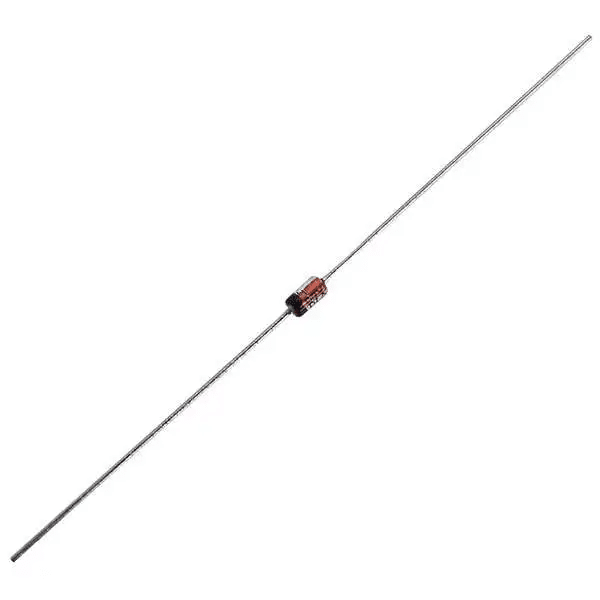
The marking “6.8V” identifies a Zener diode with a nominal Zener voltage ($V_Z$) of 6.8V. This specific voltage is highly regarded in circuit design because it sits near the transition point where the temperature coefficient of the Zener effect and the Avalanche effect largely cancel each other out, resulting in excellent voltage stability over temperature changes.
Technical Specifications
| Parameter | Specification |
| Nominal Zener Voltage ($V_Z$) | 6.8V |
| Power Dissipation ($P_D$) | 0.5W (500mW) standard |
| Package Type | DO-35 (Small Glass Axial) |
| Tolerance | $\pm 5\%$ |
| Common Part Numbers | 1N5235, BZX79-C6V8 |
Understanding Operation
To use this component effectively, it must be operated in the reverse breakdown region. When the voltage applied across the cathode (banded end) and anode exceeds 6.8V, the diode conducts to maintain that specific potential.
In a typical regulation circuit, the diode is placed in parallel with your load. Because the diode’s resistance drops significantly in breakdown, a series current-limiting resistor ($R_s$) is essential to prevent the diode from drawing excessive current and exceeding its power rating.
Key Considerations for Your Circuit
-
Thermal Safety: For a 0.5W (500mW) device, you must ensure the current ($I_Z$) stays within safe bounds. Using the formula $P = V \times I$, the maximum continuous current should be kept below ~73mA ($0.5W / 6.8V$).
-
Replacement: If you are sourcing a replacement, look for the 6.8V, 500mW rating in a DO-35 package.
-
Troubleshooting: If the voltage on your 6.8V line is pulled to ground, the Zener diode is a common point of failure. Test the component using the diode check function on your multimeter; a failed Zener will typically show a dead short (0V drop) in both directions.













Reviews
There are no reviews yet.