


Description
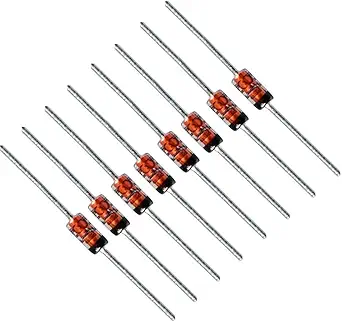
The 7.2V 0.5W Zener diode is a non-standard voltage value. In industry, diodes are typically manufactured to follow the E24 series of standard values. For a 7.2V requirement, the most common standard replacement is the 7.5V Zener diode (1N5237).
Technical Considerations & Alternatives
| Parameter | Specification |
| Nominal Zener Voltage ($V_Z$) | 7.2V (Commonly substituted with 7.5V) |
| Power Dissipation ($P_D$) | 0.5W (500mW) |
| Package Type | DO-35 (Small Glass Axial) |
| Standard Alternative | 1N5237 (7.5V) |
Why 7.2V is Rare
Most Zener diodes are manufactured at 6.8V or 7.5V. If your circuit specifically requires exactly 7.2V, you may need to:
-
Use a Precision Voltage Reference IC: If you need high accuracy (e.g., for an ADC or analog measurement), an IC like the TL431 is a better choice than a standard Zener.
-
Stack Diodes: A combination of a standard diode (approx 0.7V forward drop) in series with a 6.5V–6.8V Zener can approximate 7.2V–7.5V, though this is rarely necessary for general regulation.
-
Accept the Tolerance: If this is for general overvoltage protection, the 7.5V 1N5237 is almost always an acceptable substitute.
To function as a regulator, you must install the diode in reverse bias and include a series current-limiting resistor ($R_s$). This is critical: without this resistor, the diode would draw unregulated current, exceed its 500mW power limit, and likely fail as a short circuit.
Application & Safety Guidelines
-
Thermal Management: Using the formula $I_{Zmax} = P_D / V_Z$, your maximum current should be kept below ~69mA ($0.5W / 7.2V$).
-
Procurement: Since 7.2V is not a standard mass-produced value, you will likely need to search for the “1N5237” (7.5V) or contact a specialty component distributor if the 7.2V rating is strictly required for your application.
-
Troubleshooting: If you are using a 7.5V diode in a circuit designed for 7.2V, expect the regulated output to sit slightly higher than your original design target.














Reviews
There are no reviews yet.