


Description
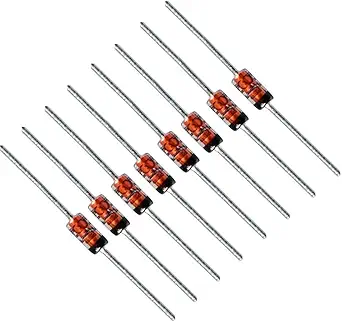
The 7.8V 0.5W Zener diode is a non-standard voltage value. Like the 7.2V variant, 7.8V does not align with the standard E24 series of preferred numbers for electronic components.
If you are designing a circuit, you will generally find that manufacturers produce the 7.5V (1N5237) or the 8.2V (1N5238) as standard alternatives.
Technical Considerations & Alternatives
| Parameter | Specification |
| Nominal Zener Voltage ($V_Z$) | 7.8V (Rare/Non-standard) |
| Power Dissipation ($P_D$) | 0.5W (500mW) |
| Package Type | DO-35 (Small Glass Axial) |
| Standard Alternatives | 1N5237 (7.5V) or 1N5238 (8.2V) |
How to Handle Non-Standard Voltages
Because a 7.8V Zener is not a mass-produced standard, you have three practical options to achieve your design goal:
-
Select the Nearest Standard Value: If this is for general voltage clamping or protection, selecting either the 7.5V or 8.2V part is the industry-standard approach.
-
Use an Adjustable Shunt Regulator: For applications requiring exact precision (e.g., analog reference circuits), consider an adjustable shunt regulator like the TL431. You can set its output voltage to exactly 7.8V using two external resistors.
-
Diode Stacking (Series): In some specialized cases, you can place a low-voltage Zener in series with a standard silicon switching diode to fine-tune the clamping voltage.
Principles of Operation
Regardless of the voltage, Zener diodes must be operated in the reverse bias configuration (cathode to the positive rail) and must include a series current-limiting resistor ($R_s$). This resistor prevents the diode from drawing excessive current, which would cause it to exceed its 500mW power limit and fail as a short circuit.
Application & Safety Guidelines
-
Thermal Management: Using the formula $I_{Zmax} = P_D / V_Z$, your maximum current should be kept below ~64mA ($0.5W / 7.8V$).
-
Procurement: Because 7.8V is not a standard manufactured value, you will likely find that searching for “7.8V Zener” yields no results or high-cost custom components. Stick to the 7.5V or 8.2V series for cost-effectiveness and availability.
-
Troubleshooting: If you are substituting a standard value, ensure your circuit can handle the slight deviation from 7.8V.












Reviews
There are no reviews yet.