
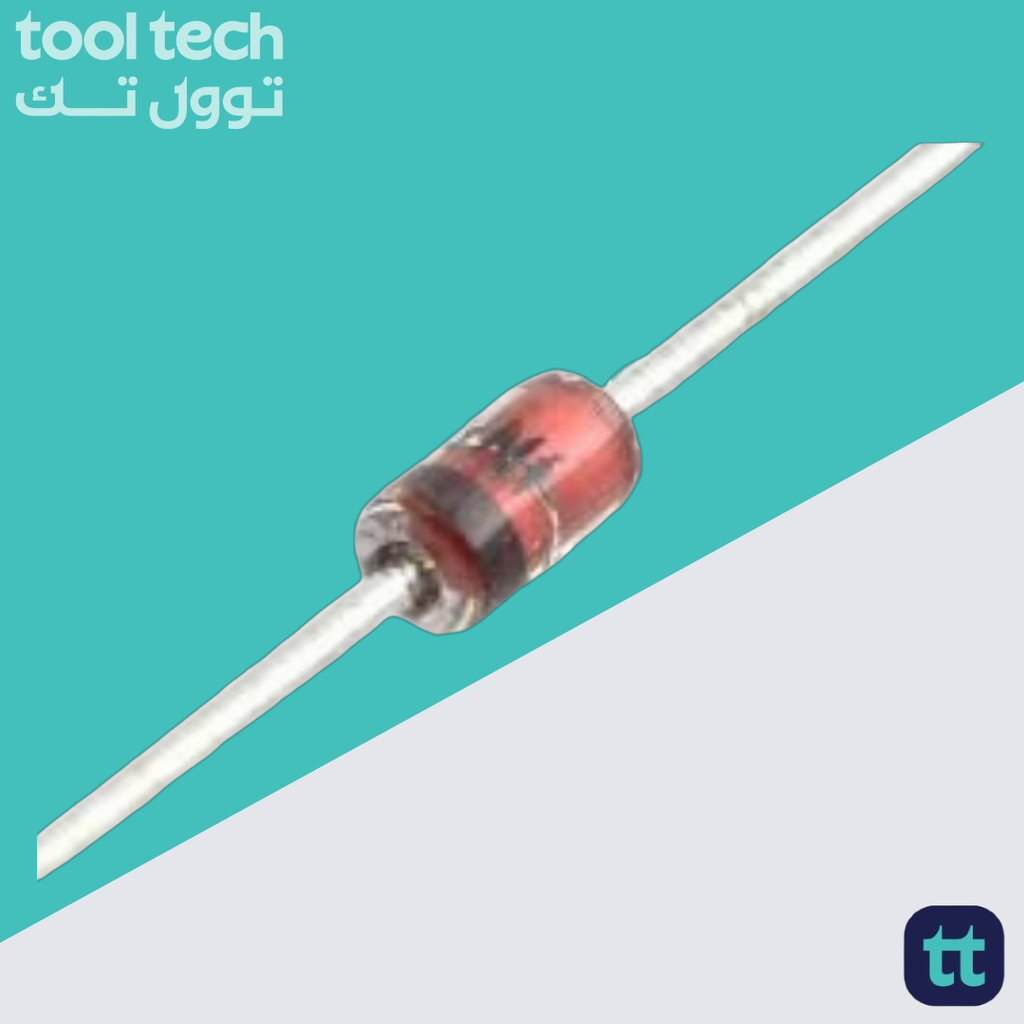



Description
The marking “15V” on a Zener diode indicates a device designed to clamp or regulate voltage at a nominal 15V.
To provide the correct technical information for your application, it is important to distinguish between the two most common power ratings for this voltage:
Technical Specifications
| Parameter | Option A (Low Power) | Option B (Standard Power) |
| Nominal Voltage ($V_Z$) | 15V | 15V |
| Power Dissipation ($P_D$) | 0.5W (500mW) | 1.0W |
| Package Type | DO-35 (Small Glass) | DO-41 (Larger Plastic/Glass) |
| Common Part # | 1N5245 / BZX79-C15 | 1N4744 / BZX85-C15 |
Understanding Zener Operation
A 15V Zener diode is commonly used to “clamp” a higher supply voltage down to a stable 15V rail or to protect sensitive electronics from voltage transients that exceed this threshold. To function correctly, it must be installed in reverse bias (cathode to the positive potential).
Critical Design Considerations
-
Series Resistor ($R_s$): You must use a series current-limiting resistor. Without it, the Zener diode will attempt to clamp the entire power supply current, exceed its power dissipation limit, and fail (usually via a short circuit).
-
Power Rating Calculation: The total power consumed by the diode is $P = V_Z \times I_Z$. If you are working with higher current sources, you must use the 1W (DO-41) version to prevent thermal failure.
-
Breakdown Knee: As the input voltage approaches 15V, the diode begins to conduct. The “knee” of this curve is where the regulation becomes stable.
Application & Selection
-
If replacing a failed component: Match the physical size first. If the original glass body is small (~4mm), it is likely a 0.5W device. If it is larger (~5mm+), it is likely a 1W device.
-
If designing a new circuit: A 1W Zener (1N4744) is generally more robust and preferred for power supply rails, while a 0.5W Zener (1N5245) is ideal for signal-level protection.

















Reviews
There are no reviews yet.