


Description
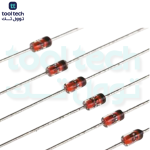
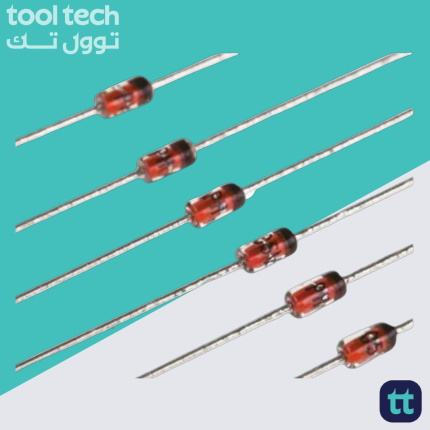
The 8V 0.5W Zener diode is a standard value used for voltage regulation and transient overvoltage protection. While 8.2V is the most common industry-standard value in this range, 8V Zener diodes are readily available and widely used in specialized circuits. The most common industry-standard part number for this range is the 1N5238 (8.2V) or specifically ordered 8V variants.
Technical Specifications
| Parameter | Specification |
| Nominal Zener Voltage ($V_Z$) | 8V |
| Power Dissipation ($P_D$) | 0.5W (500mW) |
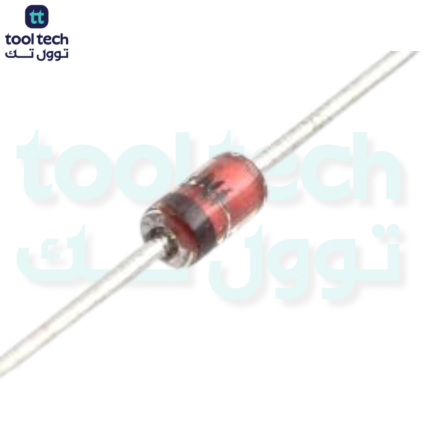
| Package Type | DO-35 (Small Glass Axial) |
| Tolerance | $\pm 5\%$ |
| Operating Temperature | -65°C to +200°C |
Understanding the Zener Principle
This component is designed to operate in the reverse breakdown region. When the voltage applied to the cathode (banded end) exceeds 8V, the diode begins to conduct, clamping the potential to 8V by shunting excess current to ground.
To function as a regulator, you must install the diode in reverse bias and include a series current-limiting resistor ($R_s$). This is critical: without this resistor, the diode would draw unregulated current, exceed its 500mW power limit, and likely fail as a short circuit.
Application & Safety Guidelines
-
Thermal Management: To keep this 500mW device safe, ensure the current ($I_Z$) flowing through it does not exceed the limit. Using the formula $I_{Zmax} = P_D / V_Z$, your maximum current should be kept below ~62.5mA ($0.5W / 8V$).
-
Procurement: You requested 2 pieces. If you cannot find a specific “8V” part, verify if your design can accommodate the standard 8.2V (1N5238), which is interchangeable in the vast majority of applications.
-
Troubleshooting: If the voltage on your 8V rail is zero or lower than expected, check the Zener diode. A failed Zener diode typically measures as a dead short (near 0 ohms) in both directions on a multimeter.













Reviews
There are no reviews yet.