


Description
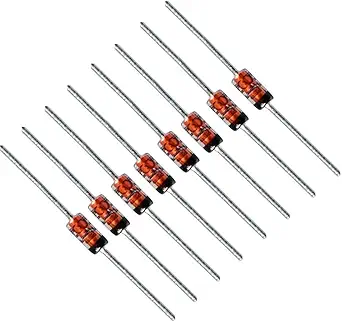
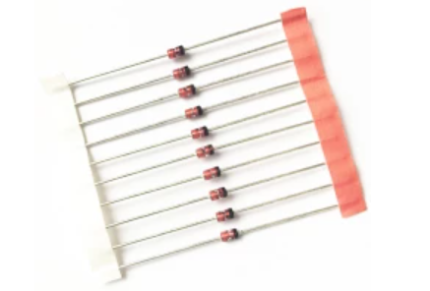
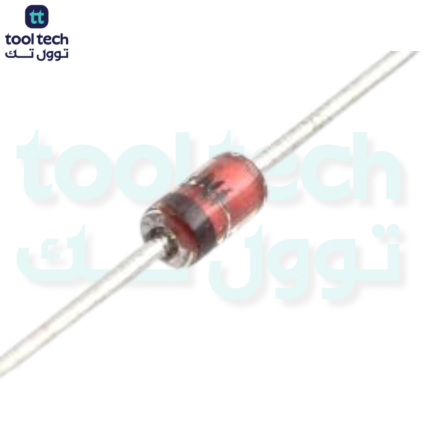
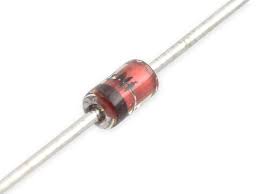
The BZX79-C30 is a precision 30V Zener diode commonly used for voltage regulation, surge protection, and as a stable reference point in higher-voltage control circuits.
Technical Specifications
| Parameter | Specification |
| Nominal Zener Voltage ($V_Z$) | 30V |
| Power Dissipation ($P_D$) | 500mW (0.5W) |
| Package Type | DO-35 (Glass Axial Lead) |
| Tolerance | $\pm 5\%$ |
| Zener Impedance ($Z_Z$) | 80 $\Omega$ (at $I_Z = 2mA$) |
Operational Overview
The BZX79-C30 is designed to operate in the reverse breakdown region. Once the applied reverse voltage across the diode reaches its 30V threshold, the device begins to conduct, effectively clamping the voltage at 30V by diverting excess current to ground.
To implement this as a regulator, the diode must be connected in reverse bias (banded end, the cathode, connected to the positive supply). A series current-limiting resistor ($R_s$) is mandatory to prevent the diode from drawing unlimited current, which would exceed its 500mW power limit and cause permanent damage.
Application & Safety Guidelines
-
Thermal Management: To ensure the diode remains within its safe operating area, calculate the maximum current ($I_Z$) using the formula:
$$I_{Zmax} = \frac{P_D}{V_Z} = \frac{0.5W}{30V} \approx 16.6mA$$For long-term reliability, it is best practice to operate well below this limit.
-
Circuit Stability: Because Zener diodes at higher voltages (like 30V) have higher internal impedance, they require a stable input voltage and careful resistor sizing to maintain a constant output under varying load conditions.
-
Troubleshooting: Use a multimeter to verify functionality. A healthy diode shows a forward voltage drop of ~0.7V in one direction and blocks current in the other (at low test voltages). If you measure near 0 ohms in both directions, the device has failed.















Reviews
There are no reviews yet.