



Description
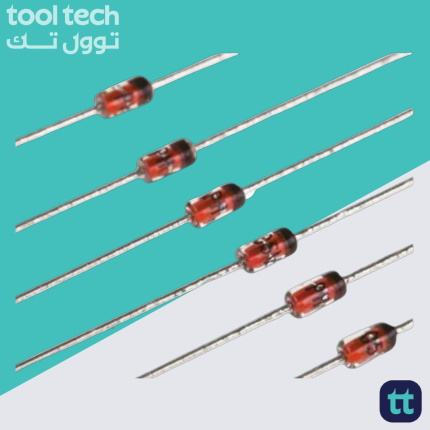
The BZX79-C8V2 is a widely used 8.2V Zener diode, highly regarded for its thermal stability. At 8.2V, the temperature coefficient of the Zener effect and the forward-bias temperature coefficient of the PN junction effectively cancel each other out, making it an ideal choice for stable voltage references and precision clamping.
Technical Specifications
| Parameter | Specification |
| Nominal Zener Voltage ($V_Z$) | 8.2V |
| Power Dissipation ($P_D$) | 500mW (0.5W) |
| Package Type | DO-35 (Glass Axial Lead) |
| Tolerance | $\pm 5\%$ |
| Zener Impedance ($Z_Z$) | 8 $\Omega$ (at $I_Z = 5mA$) |
Operational Overview
The BZX79-C8V2 is designed to operate in the reverse breakdown region. When the voltage applied to the cathode (banded end) exceeds 8.2V, the diode enters a controlled breakdown state, clamping the voltage at 8.2V by shunting excess current.
To use this as a regulator, you must connect the diode in reverse bias (cathode to the positive rail) and use a series current-limiting resistor ($R_s$). The resistor is critical: it limits the current $I_Z$ to keep the device within its 500mW power limit. Without it, the diode will draw excessive current and likely fail as a short circuit.
Application & Safety Guidelines
-
Thermal Management: To keep the 500mW device safe, ensure the current ($I_Z$) does not exceed the limit. Using the formula $I_{Zmax} = P_D / V_Z$, your maximum current should be kept below ~61mA ($0.5W / 8.2V$).
-
Stability: For optimal voltage stability, it is best practice to bias the Zener diode at a current where its dynamic impedance is low, typically around 5mA for this specific model.
-
Testing: A healthy diode will show a forward voltage drop of ~0.7V on a diode-test multimeter setting. In reverse bias (at low voltage), it should show an open circuit. If you measure near 0 ohms in both directions, the device is faulty.













Reviews
There are no reviews yet.