

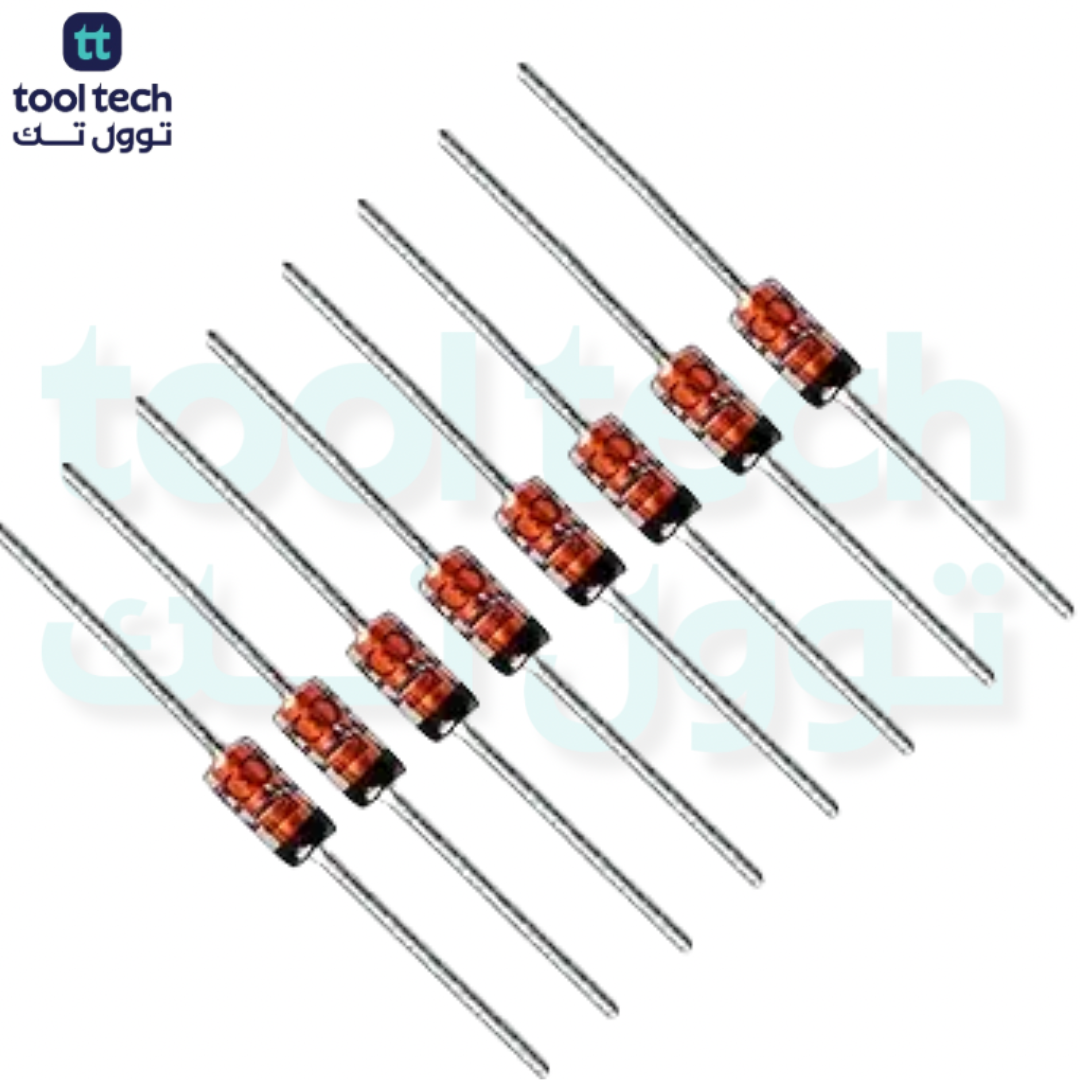
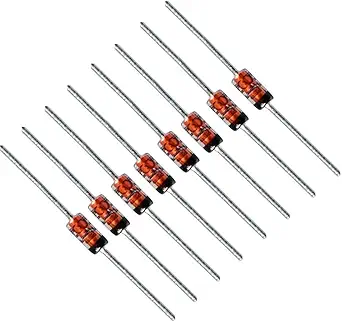
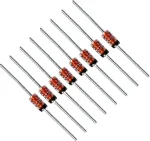

Description
The marking “C5V1” identifies a 5.1V Zener diode. In the standard naming convention, the “V” serves as the decimal point, confirming a nominal Zener voltage of 5.1V. This is one of the most widely used Zener voltages in electronics, as it is perfectly suited for regulating voltage rails in 5V-based digital logic systems.
Technical Overview
The C5V1 is designed for high-precision voltage regulation and transient suppression. Its 5.1V threshold makes it an ideal “clamp” for protecting 5V TTL (Transistor-Transistor Logic) and microcontroller inputs from dangerous overvoltage spikes.
Technical Specifications
| Parameter | Specification |
| Nominal Zener Voltage ($V_Z$) | 5.1V |
| Power Dissipation ($P_D$) | 500mW (0.5W) |
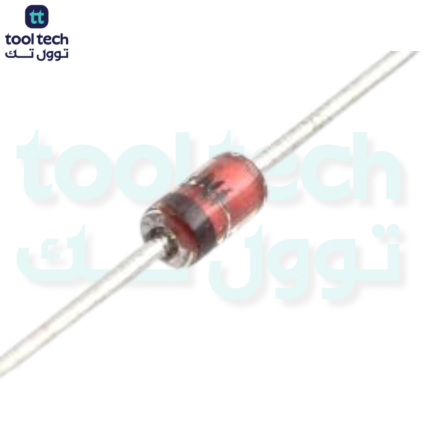
| Package Type | DO-35 (Glass Axial Lead) |
| Tolerance | $\pm 5\%$ |
| Operating Temperature | -65°C to +200°C |
Understanding the Zener Principle
The C5V1 operates in reverse bias. When the voltage applied across the diode reaches 5.1V, it enters the Zener breakdown region. At this point, the diode begins to conduct significant current to ground, preventing the voltage across the component from rising further.
This behavior creates a “clamping” effect that is vital for circuit safety. By using the Zener diode in parallel with your load, you ensure the voltage remains fixed at approximately 5.1V, provided that you have a current-limiting resistor in series with the power source.
Application & Replacement Notes
-
Signal Protection: If this component is used on a data line, it effectively “clips” any voltage spikes that exceed 5.1V, acting as a safeguard for sensitive downstream chips.
-
Component Replacement: When sourcing a replacement, look for a 5.1V, 500mW Zener diode in a DO-35 package.
-
Thermal Safety: Because this is a 500mW device, you must ensure the circuit design does not allow the diode to exceed its power dissipation limit ($P = V_Z \times I_Z$).














Reviews
There are no reviews yet.