


Description
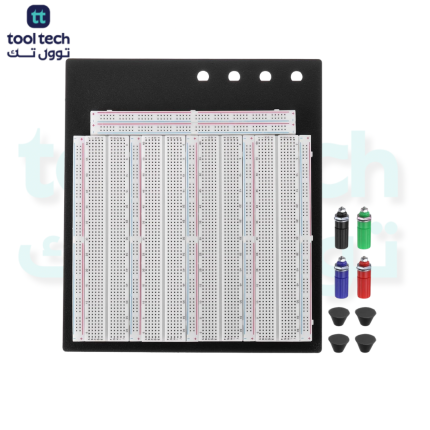
ZY-206 Solderless Breadboard – 2390 Tie Points
The ZY-206 is a high-capacity, professional-grade solderless breadboard designed for complex circuit design, rapid prototyping, and advanced electronic testing. Providing a substantial 2390 tie points, this board offers an expansive workspace for integrating multiple microcontrollers, sensor arrays, and peripheral components without the need for permanent soldering.
Technical Specifications
| Feature | Specification |
| Total Tie-Points | 2390 |
| Configuration | 3 Terminal Strips (1890 points) + 5 Distribution/Power Strips (500 points) |
| Binding Posts | 3 (standard color-coded terminals) |
| Base Plate | Powder-coated heavy-duty metal base with non-slip rubber feet |
| Material | High-impact ABS plastic (board), Nickel-plated phosphor bronze (clips) |
| Wire Compatibility | 20–29 AWG (Solid-core wire recommended) |
| Pitch | 2.54mm (0.1″) standard |
Key Features
-
Massive Prototyping Capacity: With nearly 2400 tie points, the ZY-206 is perfectly suited for intricate projects requiring large-scale integration, such as testing complex digital logic, analog signal processing, or multi-module IoT systems.
-
Integrated Power Management: The 5 dedicated distribution strips allow for clear, isolated management of multiple power rails (e.g., 5V, 3.3V, and GND), significantly reducing the risk of accidental short circuits in crowded layouts.
-
Professional Stability: Mounted on a high-quality metal base, the unit remains steady on the workbench. It prevents the board from sliding during component insertion and provides a robust foundation for heavy-handed modifications.
-
Durable Connections: The internal spring clips are constructed from nickel-plated phosphor bronze, designed to withstand thousands of insertion cycles while maintaining consistent electrical contact.
-
Color-Coded Layout: Clear markings and color-coding across the terminal and distribution strips make circuit tracing simple and intuitive, even in high-density builds.
Best Practices for Use
-
Wire Selection: Always use solid-core jumper wires for the most reliable connection. Stranded wires are often too flexible and can damage the internal spring clips or fail to make proper contact.
-
Component Leads: Keep component leads clean. If leads have been previously soldered, remove the excess solder before inserting them to ensure the clips remain tight and the contact resistance stays low.
-
Heat Awareness: While the ABS plastic is resilient, it will melt if touched by a hot soldering iron. Always solder your components onto breakout boards or wires before inserting them into the breadboard.
-
Organization: Take advantage of the three separate terminal strips to group your circuit sections (e.g., power stage, controller stage, and output stage). This makes troubleshooting much easier.















Reviews
There are no reviews yet.