


Description
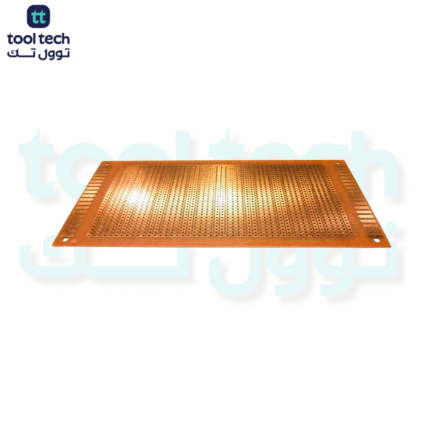
Product Overview: FR2 Phenolic Paper PCB (10cm x 15cm)
This 10cm x 15cm FR2 (Flame Retardant level 2) copper-clad laminate is a compact, budget-friendly substrate widely used for prototyping, student engineering projects, and simple, low-power electronic assemblies. Unlike FR4, which uses a fiberglass reinforcement, FR2 is composed of synthetic resin-bonded paper.
Technical Specifications
| Feature | Specification |
| Material | Phenolic Resin-Bonded Paper (FR2) |
| Dimensions | 100mm x 150mm (10x15cm) |
| Layers | Single-sided (Copper on one side) |
| Substrate Color | Typically Tan/Light Brown |
| Machinability | Excellent; easy to cut with simple tools |
Key Characteristics
-
Cost-Effective: FR2 is the most economical choice for hobbyists or educational labs where high-speed signal integrity or extreme thermal resistance is not required.
-
Easy to Process: Because it is paper-based, you can cut it to size using a utility knife or shears and drill it with standard handheld tools.
-
Thermal/Mechanical Profile: FR2 is more brittle than glass-epoxy (FR4). It has a lower glass transition temperature ($T_g$), meaning it can warp or delaminate if subjected to excessive soldering heat for too long.
-
Performance: It is designed for low-frequency/DC applications. It is not recommended for high-speed digital circuits or high-frequency RF designs.
Fabrication Tips
-
Soldering: Work quickly. Because the paper base is sensitive to heat, use a temperature-controlled iron set to a moderate level ($320^{\circ}\text{C}$ to $350^{\circ}\text{C}$) to prevent the copper pads from lifting.
-
Etching: Perfectly compatible with standard chemical etchants like Ferric Chloride.
-
Drilling: It is significantly easier on drill bits than FR4 boards, as the material is less abrasive. Use high-speed steel bits for clean, burr-free holes.
Typical Applications
-
Entry-Level DIY Electronics: Breadboard-style projects moved to a permanent, soldered format.
-
Educational Demonstrations: Teaching students the basics of PCB etching, through-hole component assembly, and soldering.
-
Low-Power Controllers: Simple timers, light-sensing circuits, or basic LED driver boards.











Reviews
There are no reviews yet.