


Description
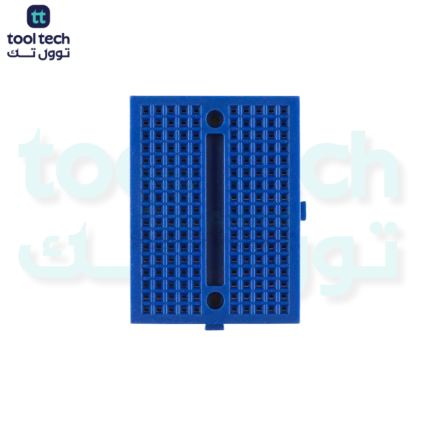
170-Tie Point Mini Breadboard – Black
The 170-Tie Point Mini Breadboard is an ultra-compact, professional-grade prototyping tool. Its small footprint and sleek black finish make it the ideal solution for minimal space requirements, such as Arduino Nano projects, wearable electronics, or final-stage sensor nodes where you need to secure a small circuit in a confined space.
Technical Specifications
| Feature | Specification |
| Total Tie-Points | 170 |
| Dimensions | 4.5cm x 3.5cm x 0.85cm |
| Material | ABS plastic (housing), Nickel-plated phosphor bronze (contacts) |
| Mounting | Self-adhesive backing (peel-and-stick) |
| Interlocking | Yes (modular tabs for connecting multiple boards) |
| Wire Compatibility | 20–29 AWG (Solid-core wire recommended) |
Key Features
-
Minimalist Footprint: Its tiny size allows it to fit virtually anywhere, making it perfect for mounting directly onto a chassis or inside a compact project enclosure.
-
Adhesive-Backed: The integrated adhesive backing provides a secure mount, ensuring your circuit doesn’t shift during operation or while you are connecting external wires.
-
Modular Versatility: The interlocking tabs allow you to daisy-chain several boards together if your project grows, giving you the flexibility to build small or large, depending on the need.
-
Standardized Layout: Despite its small size, it maintains a standard 2.54mm (0.1″) pitch, making it fully compatible with all standard DIP-packaged ICs, headers, and jumper wires.
Best Practices for Use
-
Wire Selection: Use 22–24 AWG solid-core wire. Stranded wire is prone to fraying and can permanently deform the delicate internal contact clips, leading to intermittent connections.
-
Installation: Clean the surface of your project box with isopropyl alcohol before applying the adhesive backing to ensure a long-lasting, sturdy bond.
-
Insertion Force: When using microcontrollers or long-header components, insert them vertically. Applying force at an angle can cause the small housing to crack or the pins to bend.
-
Organization: Because of the limited space, use different colors of jumper wires to distinguish between power (red), ground (black/blue), and signal lines to avoid “rat’s nest” wiring.














Reviews
There are no reviews yet.