


Description
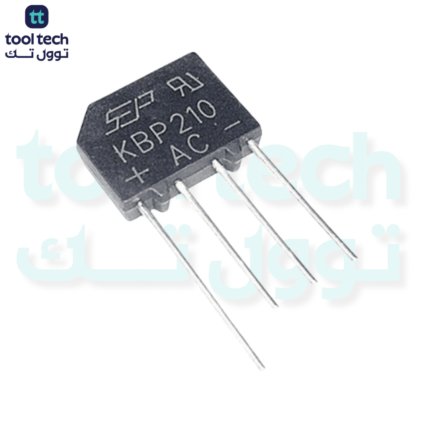
A 2A circular 4-pin bridge rectifier is a compact, pre-packaged component that replaces four individual rectifier diodes. By integrating the full-bridge circuit into one housing, it saves board space and ensures better thermal balance between the diodes.
Common Part Example: W02, W04, W06, W10 Series
While ratings vary, the W-series (e.g., W02, W04) is the most common industry standard for this physical form factor. The number in the model (e.g., “04”) often refers to the voltage rating (400V, 600V, etc.).
Technical Specifications
| Parameter | Typical Rating |
| Average Forward Current ($I_O$) | 1.5A – 2.0A |
| Peak Repetitive Reverse Voltage ($V_{RRM}$) | 200V – 1000V (varies by suffix) |
| Non-Repetitive Surge Current ($I_{FSM}$) | 50A |
| Operating Temperature | -55°C to +150°C |
| Package Type | WOB (Circular / Round) |
Understanding the Pins
The circular package has four pins labeled specifically to ensure you connect your AC input and DC output correctly.
-
AC Pins (~): Usually two adjacent pins in the middle. The AC input from your transformer goes here (polarity does not matter for these two).
-
Positive Pin (+): The rectified positive DC output.
-
Negative Pin (-): The rectified negative DC output (or ground).
Why Use a Bridge Rectifier Module?
-
Space Efficiency: Instead of laying out four individual diodes (like 1N4007s) and ensuring they are spaced correctly for cooling, a single module handles the routing internally.
-
Matched Diodes: In a module, the internal diodes are thermally matched during manufacturing. This ensures the load is shared evenly, which is harder to achieve with four separate discrete diodes.
-
Simplified Assembly: You only have one component to solder and one heat path to consider, rather than four individual components.
Important Design Considerations
-
-
Polarity Identification: Look closely at the markings on the top or side of the component. The (+) pin is usually marked with a beveled corner or a plus sign. Connecting the AC source to the DC pins will result in a dead short, which will likely destroy the rectifier and potentially blow your fuse or damage your transformer.
-
Heat Dissipation: Even though this is rated for 2A, it will get warm. If you are operating at the full 2A current, ensure there is adequate airflow around the component. Do not bury it in a closed plastic box without ventilation.
-
Voltage Rating: Always check the specific part number printed on the component. A “W02” is only rated for 200V; do not use it for applications where the peak voltage might exceed that. For universal AC mains (120V/240V), always use at least a W06 (600V) or W10 (1000V).
-
Quick Selection Checklist
-
Current: Are you pulling exactly 2A? If so, consider a slightly higher-rated component (e.g., a 4A bridge) to run the system cooler and increase reliability.
-
Voltage: Ensure the $V_{RRM}$ is at least double your peak AC input voltage for safety.
-
Physical Size: Ensure the lead spacing (pitch) matches your PCB layout, as different manufacturers may have slightly different pin footprints.














Reviews
There are no reviews yet.