



Description
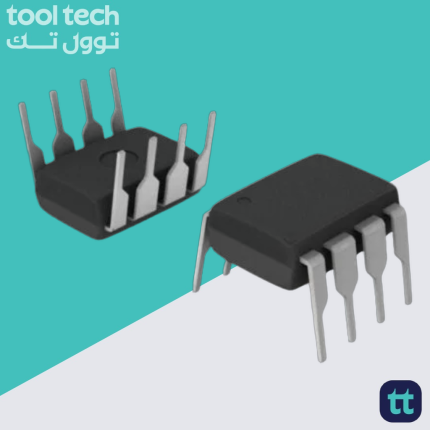
The LM358 is a classic, widely used dual operational amplifier (op-amp) integrated circuit. It is a staple in electronics because it is inexpensive, versatile, and specifically designed to work well with single power supplies.
Think of it as a “Swiss Army knife” for analog circuits—it contains two independent, high-gain op-amps within a single 8-pin package.
Key Features
-
Dual-Channel: Contains two independent amplifiers in one 8-pin chip.
-
Single Supply Operation: Unlike many older op-amps that require a dual (positive/negative) power supply, the LM358 operates perfectly with just a single supply voltage ($3\text{V}$ to $32\text{V}$).
-
Low Power Consumption: It draws very little current (typically $\sim 500\text{ }\mu\text{A}$), making it ideal for battery-operated devices.
-
Common-Mode Range: The input range includes ground, which is crucial for many sensor-based applications where you are measuring signals near $0\text{V}$.
-
Internal Compensation: It is internally frequency-compensated, meaning it is stable for most standard amplifier configurations without needing extra components to prevent oscillation.
Pinout Configuration
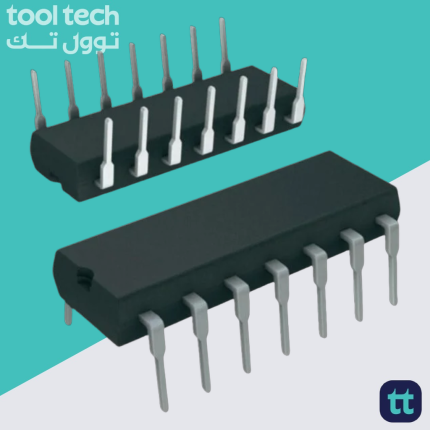
The LM358 typically comes in an 8-pin DIP (Dual In-line Package) or various surface-mount packages.
| Pin | Function | Description |
| 1 | Output 1 | Output of the first op-amp. |
| 2 | Inverting Input 1 | Negative input for the first op-amp. |
| 3 | Non-Inverting Input 1 | Positive input for the first op-amp. |
| 4 | Ground (VSS) | Connected to the ground or negative terminal. |
| 5 | Non-Inverting Input 2 | Positive input for the second op-amp. |
| 6 | Inverting Input 2 | Negative input for the second op-amp. |
| 7 | Output 2 | Output of the second op-amp. |
| 8 | VCC+ | Positive power supply ($3\text{V}$ to $32\text{V}$). |
Common Applications
Because it is reliable and easy to use, the LM358 is found in a vast range of projects:
-
Signal Conditioning: Boosting weak signals from sensors (e.g., LDRs, thermistors) so they can be read by a microcontroller.
-
Voltage Comparators: Comparing a sensor signal against a reference voltage to trigger an event (e.g., turning on a light when it gets dark).
-
Active Filters: Creating low-pass or high-pass filters to clean up noisy signals.
-
Voltage Followers (Buffers): Isolating a high-impedance source from a low-impedance load to prevent signal loading.
Technical Limitations
While excellent for general-purpose use, it is not “high-fidelity.”
-
Bandwidth: It has a gain-bandwidth product of about $1\text{ MHz}$, so it is not suitable for high-frequency or high-speed applications.
-
Crossover Distortion: Because of its output stage design, it can exhibit “crossover distortion” at very low output voltages, which makes it less ideal for high-quality audio amplification compared to specialized audio op-amps














Reviews
There are no reviews yet.