


Description
The LM386 is a classic low-voltage audio power amplifier designed specifically for battery-powered applications. Unlike the operational amplifiers we discussed previously (which are designed for signal processing), the LM386 is a power amplifier intended to drive low-impedance loads like small loudspeakers.
Key Characteristics
-
Application: Ideal for driving small speakers (typically $4 \, \Omega$ to $32 \, \Omega$).
-
Supply Voltage: Very flexible, operating from $4\text{V}$ to $12\text{V}$ or $15\text{V}$ (depending on the specific sub-version).
-
Gain: The internal voltage gain is set to 20 by default, but it can be adjusted up to 200 by placing a capacitor and resistor between pins 1 and 8.
-
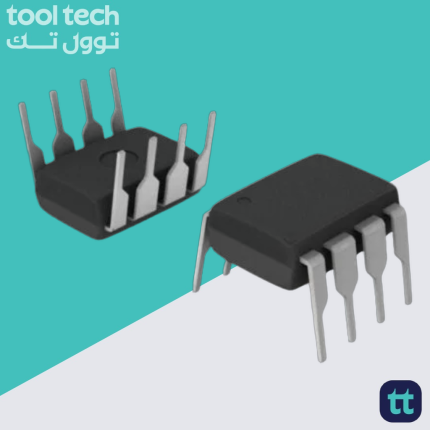
Package: Typically comes in an 8-pin DIP (Dual-in-Line) package.
Pinout Configuration (DIP-8)
| Pin | Function | Description |
| 1 | Gain | Used to set gain (connect cap/resistor) |
| 2 | Inverting Input (-) | Connect to ground for non-inverting setup |
| 3 | Non-Inverting Input (+) | Audio signal input |
| 4 | GND | Ground |
| 5 | Output | Connect to speaker (via a coupling capacitor) |
| 6 | V+ | Power supply (typically $4\text{V}$ to $12\text{V}$) |
| 7 | Bypass | Connect capacitor to ground for ripple rejection |
| 8 | Gain | Used to set gain (connect cap/resistor) |
Understanding the “N-1” Suffix
The “N-1” indicates the specific manufacturing and power rating:
-
N: Plastic DIP package.
-
-1: This is the standard power version. It is capable of delivering approximately 0.25W to 0.5W into an $8 \, \Omega$ load, depending on the supply voltage.
Important Design Notes for Success
-
Output Coupling Capacitor: Because this is a single-supply amplifier, the DC output level sits at roughly $V_{CC}/2$. You must use a capacitor (typically $220 \, \mu\text{F}$ to $470 \, \mu\text{F}$) between Pin 5 and your speaker to block DC current, otherwise, you could damage the speaker coil.
-
Gain Adjustment:
-
Gain = 20: Leave pins 1 and 8 open.
-
Gain = 200: Connect a $10 \, \mu\text{F}$ capacitor between pins 1 and 8.
-
-
Stability: The LM386 can be prone to high-frequency oscillation if the layout is messy. Keep your leads short and include a small decoupling capacitor (e.g., $0.1 \, \mu\text{F}$) as close to the V+ pin (Pin 6) as possible.
Why it’s still popular
-
Simplicity: It requires very few external components—often just a few capacitors and a potentiometer for volume control—to get sound out of a speaker.
-
Battery Power: It is the “go-to” chip for DIY hobbyist projects like guitar practice amps, walkie-talkies, and small synth modules.














Reviews
There are no reviews yet.