





Description
oduct Specifications (HC-SR501)
| Feature | Specification |
| Operating Voltage | 4.5V to 20V DC |
| Quiescent Current | < 50µA (very low power consumption) |
| Output Level | 3.3V (High) / 0V (Low) |
| Detection Range | Adjustable, typically 3m to 7m |
| Detection Angle | < 110° cone angle |
| Time Delay | Adjustable (approx. 5 seconds to 5 minutes) |
| Operating Temp | -15°C to +70°C |
How a PIR Sensor Works
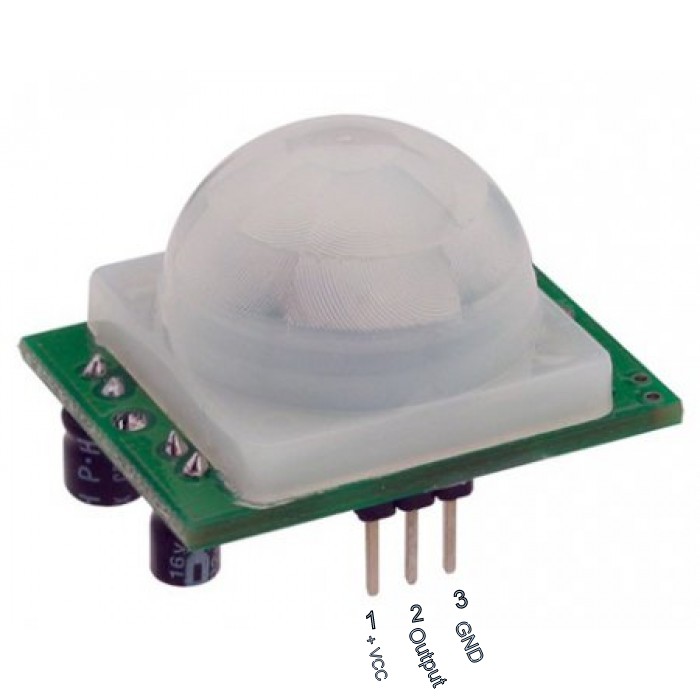
PIR sensors are “passive,” meaning they do not emit any energy (like radar or ultrasonic sensors). Instead, they detect the infrared energy naturally emitted by humans and animals.
-
Pyroelectric Elements: Inside the sensor are two sensitive slots. When the sensor is idle, both slots detect the same amount of ambient infrared radiation.
-
Detection of Change: When a warm body (like a person) moves across the field of view, it intercepts one slot before the other. This creates a differential change in temperature between the two slots.
-
Output Trigger: The onboard circuitry detects this difference, amplifies it, and switches the output pin to HIGH.
-
Fresnel Lens: The white, dome-shaped cover you see is a Fresnel lens. It divides the field of view into many small detection “zones” and focuses the infrared light onto the sensing elements, significantly increasing the sensor’s range and sensitivity.
Key Adjustable Features
Most modules like the HC-SR501 feature two potentiometers (small turning knobs) on the board:
-
Sensitivity Adjustment: Controls the distance the sensor can “see” (3m to 7m).
-
Time Delay Adjustment: Controls how long the output pin stays HIGH after motion is detected.
Common Troubleshooting Tips
-
Warm-up Time: PIR sensors typically require about 30–60 seconds to initialize when first powered on. During this time, they may trigger randomly.
-
Environmental Interference: Because they detect heat, avoid pointing them directly at heat sources like radiators, heaters, windows exposed to direct sunlight, or air conditioning vents, as these can cause false triggers.
Are you planning to integrate this into a specific project, such as an Arduino or Raspberry Pi automation system, or would you like to know how to adjust its settings for your environment?
















Reviews
There are no reviews yet.