




Description
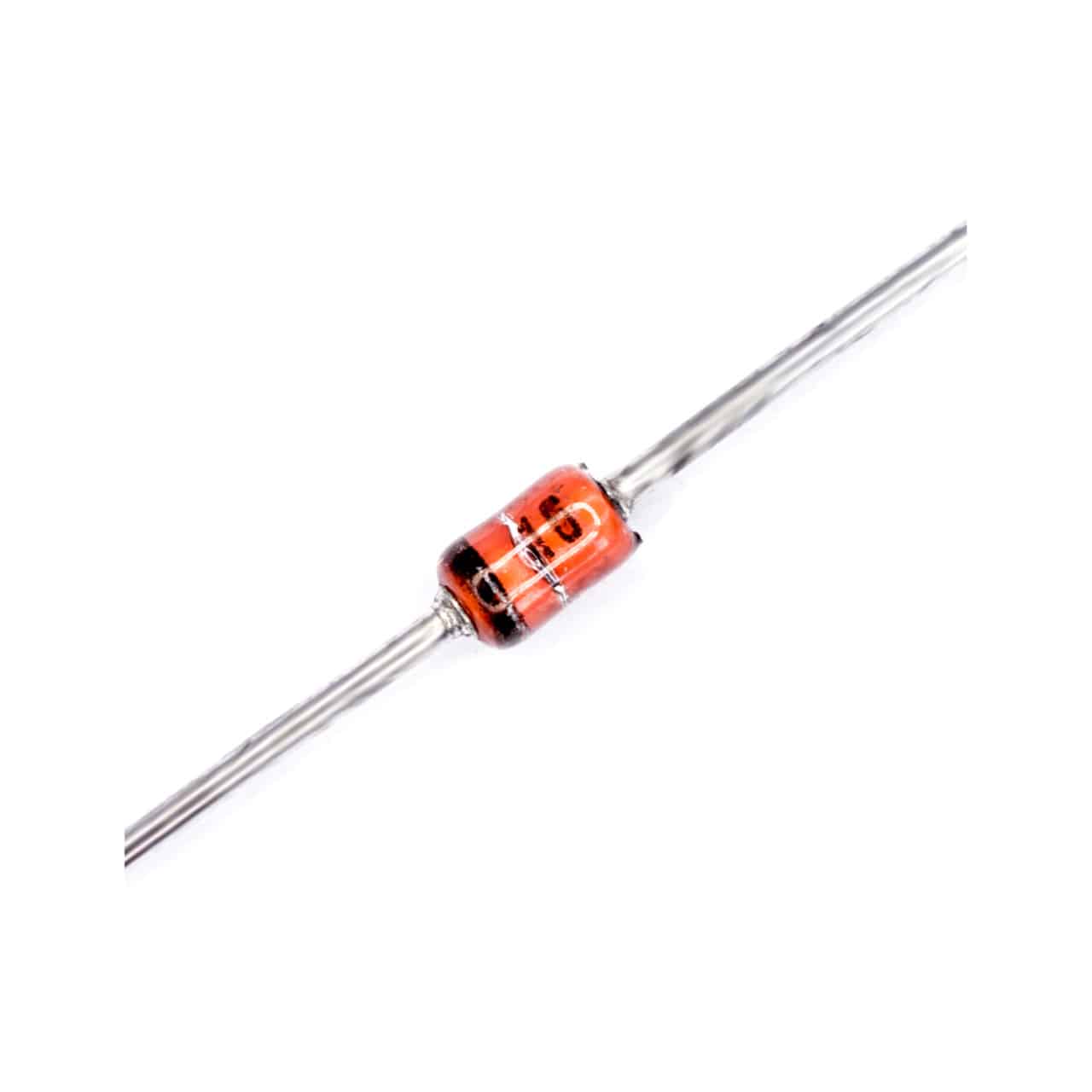
The 9.1V 0.5W Zener diode is a precision component designed for voltage regulation and transient overvoltage protection in electronic systems. It is most commonly identified by the industry-standard part numbers 1N5239 or BZX79-C9V1.
Technical Specifications
| Parameter | Specification |
| Nominal Zener Voltage ($V_Z$) | 9.1V |
| Power Dissipation ($P_D$) | 0.5W (500mW) |
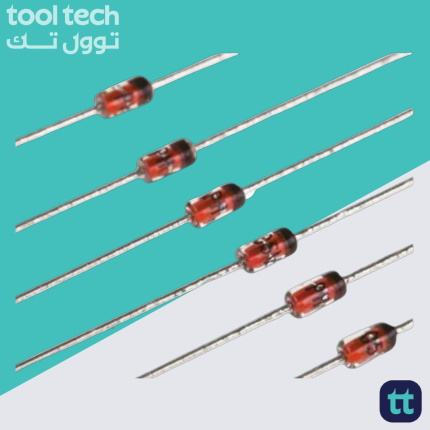
| Package Type | DO-35 (Small Glass Axial) |
| Tolerance | $\pm 5\%$ |
| Operating Temperature | -65°C to +200°C |
Operating Principle
This diode is engineered to operate in the reverse breakdown region. When the voltage across the diode reaches 9.1V, the device transitions into a conductive state, “clamping” the voltage to 9.1V by shunting excess current to ground.
To function as a regulator, you must install the diode in reverse bias (cathode to the higher potential) and include a series current-limiting resistor ($R_s$). Without this resistor, the diode would draw unregulated current, exceed its 500mW power limit, and likely fail as a short circuit.
Application & Replacement Notes
-
Thermal Management: Because this is a 500mW device, you must ensure the current ($I_Z$) remains within safe limits. Using the formula $I_{Zmax} = P_D / V_Z$, your maximum current should be kept below ~55mA ($0.5W / 9.1V$).
-
Replacement: When sourcing a replacement, ensure it is a 9.1V 500mW Zener diode in a DO-35 package. Using a higher wattage diode (like 1W) is acceptable as long as it fits the PCB space.
-
Troubleshooting: If your circuit rail is failing, use a multimeter to test the Zener. A common failure mode is a dead short (near 0 ohms) in both directions.













Reviews
There are no reviews yet.