


Description
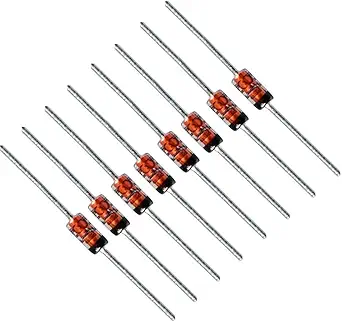
The BZX79-C15 is a reliable and widely used 15V Zener diode, commonly found in applications requiring voltage stabilization for CMOS circuits, relay driving, and reference voltage generation.
Technical Specifications
| Parameter | Specification |
| Nominal Zener Voltage ($V_Z$) | 15V |
| Power Dissipation ($P_D$) | 500mW (0.5W) |
| Package Type | DO-35 (Glass Axial Lead) |
| Tolerance | $\pm 5\%$ |
| Zener Impedance ($Z_Z$) | 30 $\Omega$ (at $I_Z = 5mA$) |
Operational Overview
The BZX79-C15 operates in the reverse breakdown region. When the reverse voltage reaches the 15V threshold, the diode breaks down and conducts, clamping the voltage at 15V.
To function as a voltage regulator, you must connect the diode in reverse bias (banded end toward the positive rail) and include a series current-limiting resistor ($R_s$). Without this resistor, the diode would draw unregulated current directly from the source, causing the device to exceed its 500mW power limit and fail.
Application & Safety Guidelines
-
Thermal Management: The maximum current ($I_Z$) allowed through this device is calculated as:
$$I_{Zmax} = \frac{P_D}{V_Z} = \frac{0.5W}{15V} \approx 33.3mA$$To ensure longevity, it is best practice to keep your operating current well below this 33mA limit.
-
Circuit Design: For the most stable output voltage, aim for an operating current that keeps the diode in the “knee” region of its characteristic curve, typically between 5mA and 20mA.
-
Troubleshooting: Use a multimeter to verify functionality. A healthy diode shows a forward voltage drop of 0.6V–0.7V in one direction and acts as an open circuit in the other (at low test voltages). A shorted diode—a common failure mode due to heat—will show 0 ohms in both directions.












Reviews
There are no reviews yet.